Power for OLS with three continuous predictors
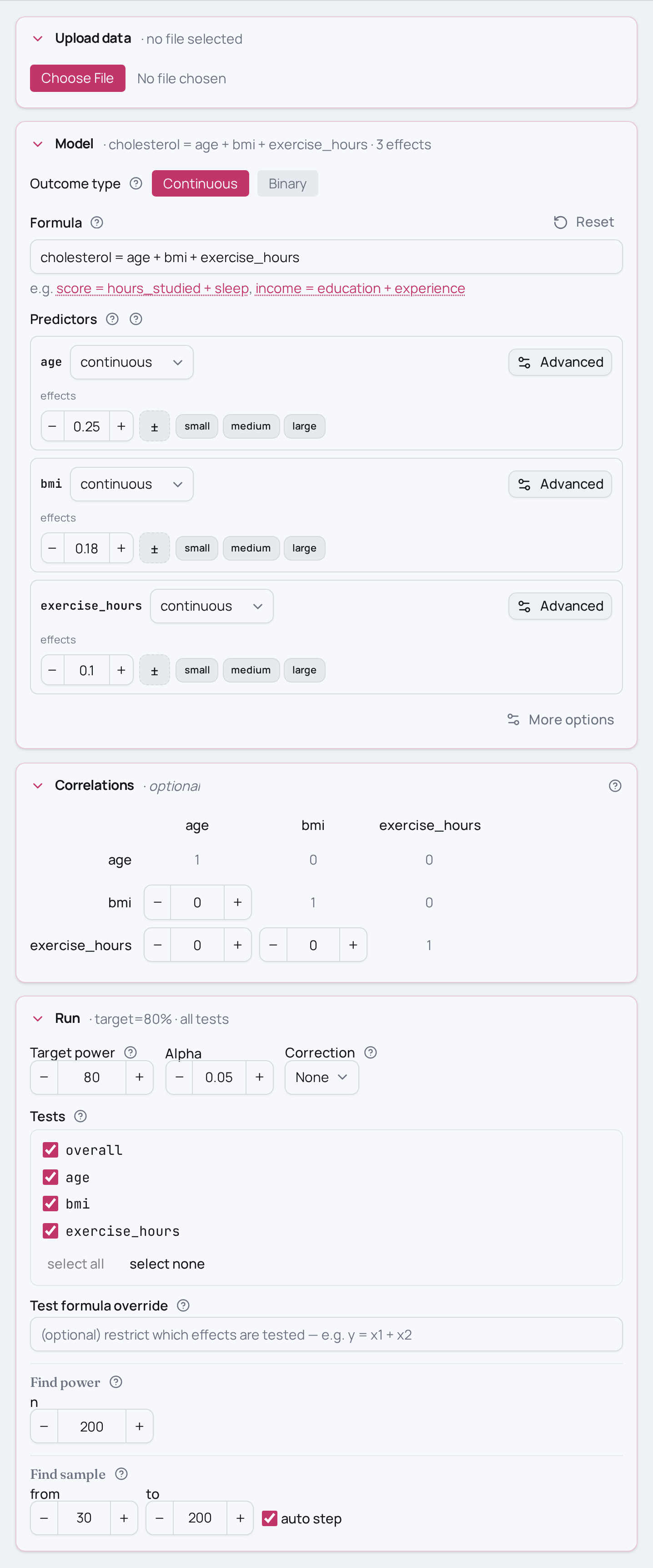
Do age, BMI, and weekly exercise hours each independently predict cholesterol
once the others are held constant? Three continuous predictors entered together
— no groups, no interactions, just parallel main effects. As an MCPower formula
this is cholesterol ~ age + bmi + exercise_hours: an OLS model with three
additive continuous slopes.
Variations
- More or fewer predictors. Drop
exercise_hoursfor a two-predictor model, or keep adding terms (+ blood_pressure + biomarker_level) — give each a name and an effect size and the setup is unchanged. - Different effect-size mix. The numbers here are standardised slopes on the
continuous benchmark scale (small
0.10, medium0.25, large0.40); set each predictor to whatever you expect, e.g.age=0.40, bmi=0.10, exercise_hours=0.10. - Find the N instead of the power. Swap
find_power(sample_size=200, …)forfind_sample_size(target_test="age, bmi, exercise_hours", from_size=50, to_size=400)to get the smallest N that reaches 80% power. - Correlated predictors. If your three measures are themselves related, add
set_correlations("corr(age, bmi)=0.3")— collinearity drains power, so it is worth modelling. - Same design, other fields:
- Ecology:
plant_biomass ~ rainfall + soil_nitrogen + temperature— three environmental drivers of biomass; same additive three-predictor OLS shape. - Social:
wage ~ years_education + experience_years + tenure— three continuous predictors of wage; same formula structure.
- Ecology:
Not this setup?
- Two continuous predictors — the same additive shape with one fewer term.
- Many continuous covariates — when the predictor list grows beyond a handful.
- A single continuous predictor — the plain simple-regression case, one slope only.
If you'd rather have…
- Two predictors that interact (moderation) — let two of your continuous predictors interact instead of just adding them.
- A full three-way interaction — go further to a three-way interaction among three continuous predictors.
- A binary plus continuous predictors — swap one continuous predictor for a binary one (mixed binary + continuous, parallel slopes).
- An interaction plus a control covariate — keep a continuous interaction but add a separate covariate as a control.
Copy-paste setup
Python setup
from mcpower import MCPower

# Three continuous predictors, additive (no interactions): each contributes
# independently to the outcome on the standardised effect scale.
model = MCPower("cholesterol = age + bmi + exercise_hours")

# Standardised slopes: age medium (0.25), bmi small-to-medium (0.18), exercise_hours small (0.10).
model.set_effects("age=0.25, bmi=0.18, exercise_hours=0.10")

model.set_seed(2137)
model.set_simulations(1600)

model.find_power(sample_size=200, target_test="age, bmi, exercise_hours")
R setup
suppressMessages(library(mcpower))

# Three continuous predictors, additive (no interactions): each contributes
# independently to the outcome on the standardised effect scale.
model <- MCPower$new("cholesterol ~ age + bmi + exercise_hours")

# Standardised slopes: age medium (0.25), bmi small-to-medium (0.18), exercise_hours small (0.10).
model$set_effects("age=0.25, bmi=0.18, exercise_hours=0.10")

model$set_seed(2137)
model$set_simulations(1600)

invisible(model$find_power(sample_size = 200, target_test = "age, bmi, exercise_hours"))
App setup screenshot