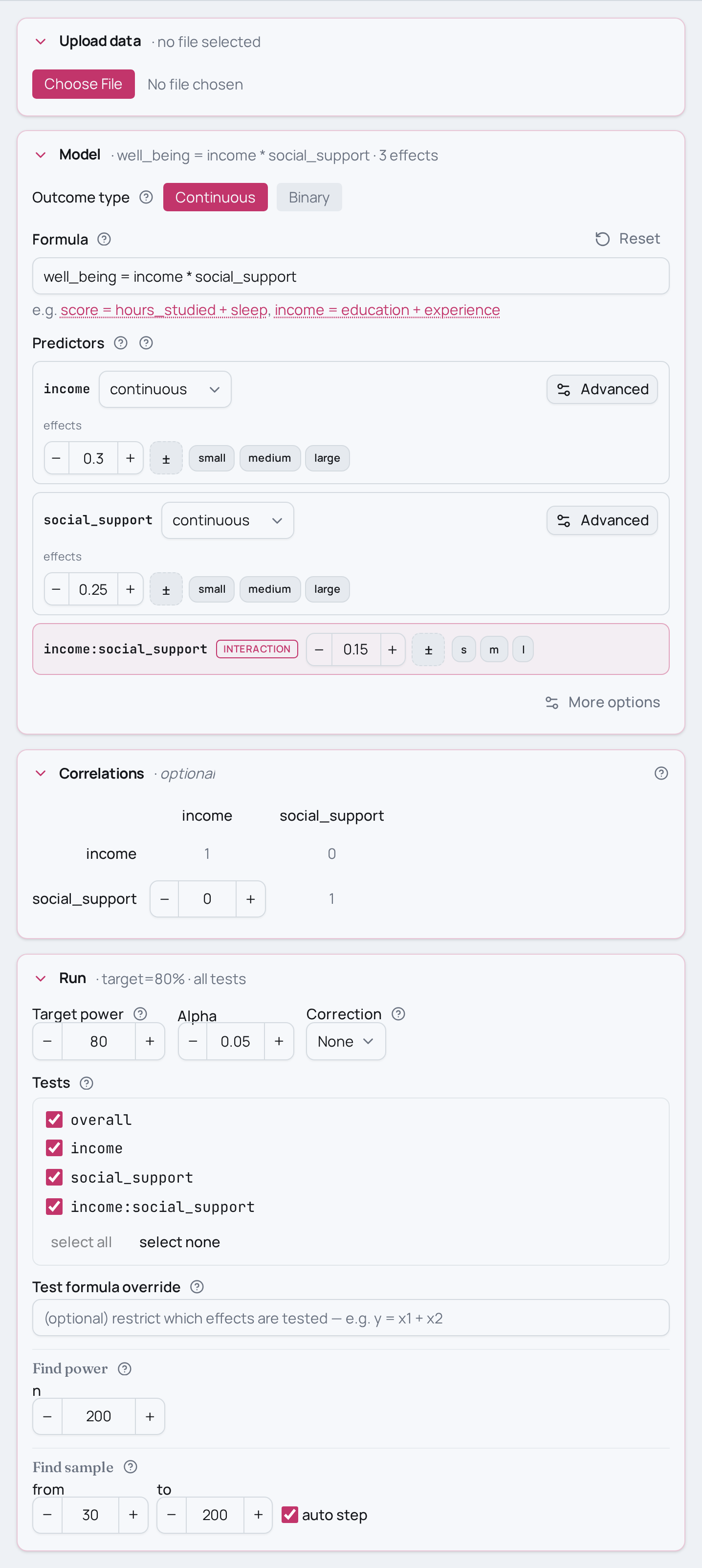
Power for a continuous interaction (moderation)
You measured a continuous outcome well_being and two continuous predictors, income and
social_support. The question is not just whether each one matters on its own, but whether
the slope of income changes across levels of social_support — a continuous-by-continuous
interaction. As an MCPower formula that is well_being ~ income * social_support, where *
expands to both main effects plus their product term (income + social_support + income:social_support).
The test that carries the moderation hypothesis is the interaction coefficient income:social_support.
Variations
- Test the whole model, not just the interaction. Swap
target_test="income:social_support"fortarget_test="all"to get power for each main effect, the interaction, and the omnibus test in one run. - Weaker or stronger moderation. The interaction effect is the uncertain
one — re-run with
income:social_support=0.10(small) orincome:social_support=0.25(medium) to see how quickly the required sample size moves. - Correlated predictors. Real moderators are rarely independent of the
variable they moderate. Add
set_correlations("corr(income, social_support)=0.3")to see how collinearity erodes power for the product term. - Find the N instead of the power. Replace the
find_powercall withfind_sample_size(target_test="income:social_support", from_size=100, to_size=600, by=25)to sweep for the smallest sample that reaches 80% power on the interaction. - Same design, other fields:
- Clinical:
blood_pressure ~ dose * baseline_bp— does a drug's blood-pressure effect depend on the patient's baseline level? - Ecology:
growth_rate ~ temperature * moisture— does the temperature effect on growth rate depend on soil moisture?
- Clinical:
Not this setup?
- Two-predictor multiple regression
- Three-way continuous interaction
- Continuous moderation with a covariate
- Interaction-only term (no lower-order main of one predictor)
If you'd rather have…
- Continuous moderation with a covariate — same continuous
income*social_supportmoderation but with an added covariate to adjust for. - Three-way continuous interaction — extend to a three-way continuous interaction
(
income * social_support * years_education). - Binary-by-continuous moderation — moderation where the moderator is binary instead of
continuous (
sex * age). - ANCOVA with treatment-by-covariate interaction (homogeneity of slopes) — moderation by a continuous covariate in a group design (ANCOVA, homogeneity of slopes).
- Logistic continuous-by-continuous moderation — the same continuous-by-continuous moderation on a binary outcome (logistic).
Copy-paste setup
Python setup
from mcpower import MCPower

# Continuous-by-continuous moderation: does the effect of income on well_being depend on social_support?
# '*' expands to the two main effects plus their interaction (income + social_support + income:social_support).
model = MCPower("well_being = income * social_support")

# Standardised effects. Main effects are moderate; the interaction (the test of
# interest) is smaller, as moderation effects usually are.
model.set_effects("income=0.30, social_support=0.25, income:social_support=0.15")

# Power for the interaction term at N=200.
model.find_power(sample_size=200, target_test="income:social_support")
R setup
suppressMessages(library(mcpower))

# Continuous-by-continuous moderation: does the effect of income on well_being depend on social_support?
# '*' expands to the two main effects plus their interaction (income + social_support + income:social_support).
model <- MCPower$new("well_being ~ income * social_support")

# Standardised effects. Main effects are moderate; the interaction (the test of
# interest) is smaller, as moderation effects usually are.
model$set_effects("income=0.30, social_support=0.25, income:social_support=0.15")

# Power for the interaction term at N=200.
invisible(model$find_power(sample_size = 200, target_test = "income:social_support"))
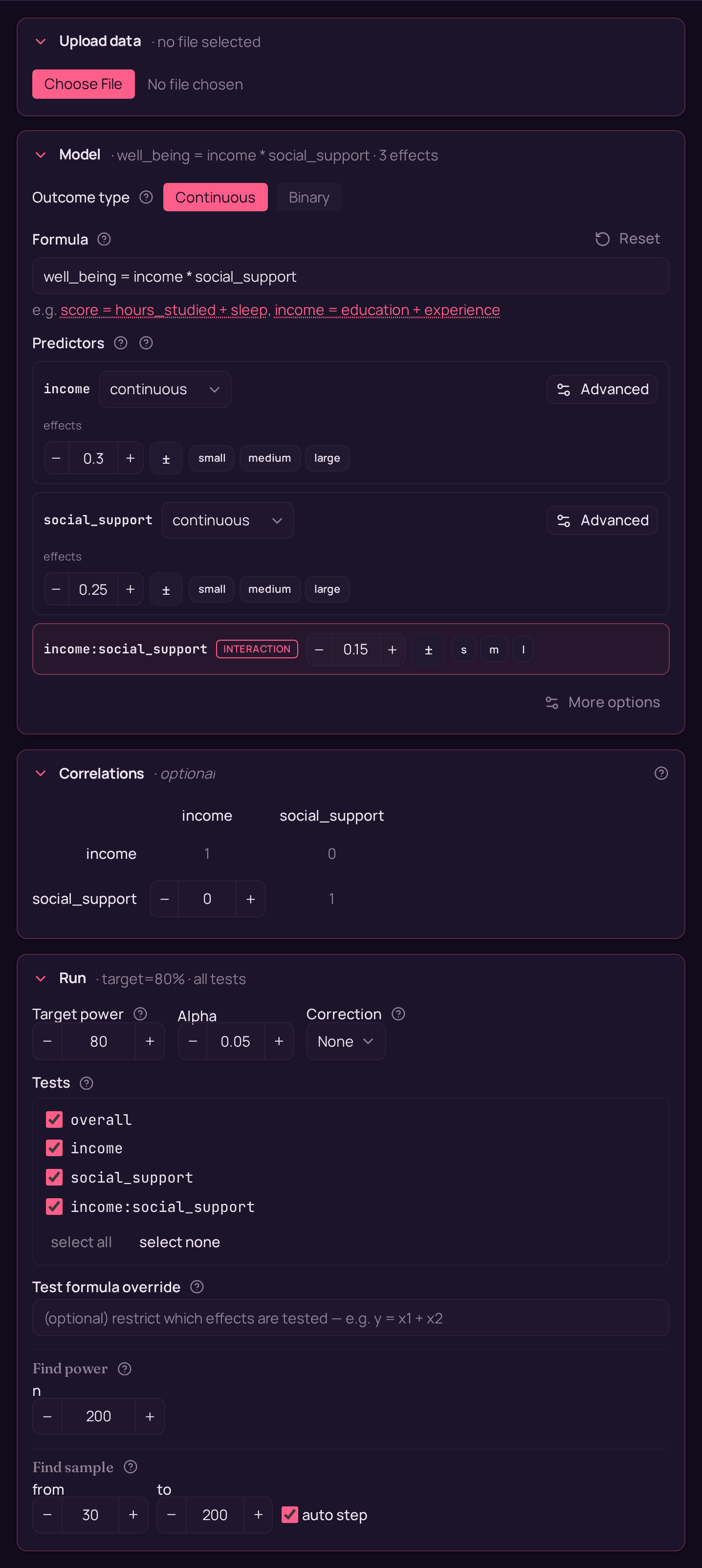
App setup screenshot