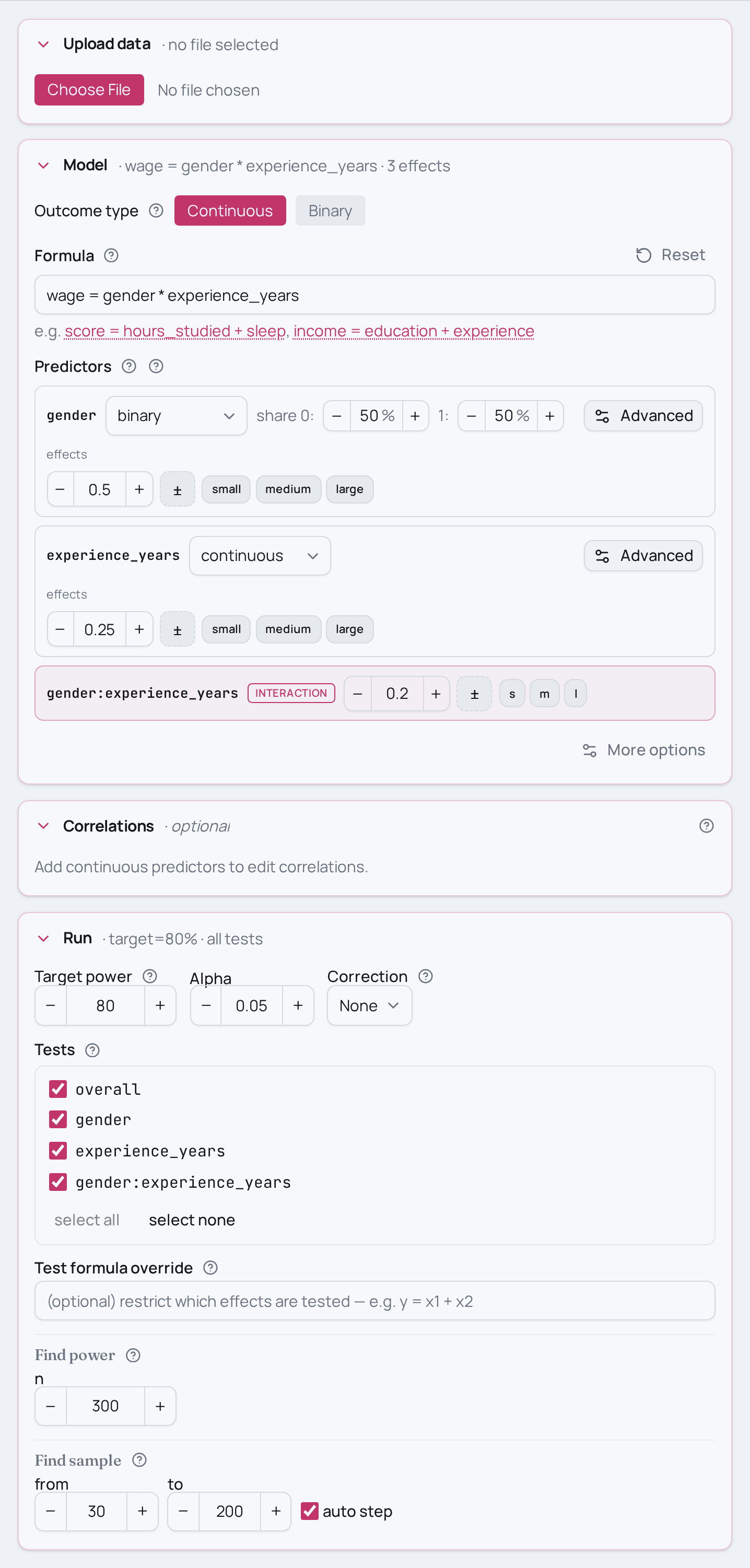
Power for binary-by-continuous moderation
You measured wage as a continuous outcome and want to know whether the slope of
experience_years on wage is different for the two gender groups — a
binary-by-continuous moderation (a "does the experience effect depend on
gender?" test). In MCPower terms the model is wage ~ gender * experience_years,
where * expands to gender + experience_years + gender:experience_years; the
gender:experience_years term is the moderation you actually care about.
Variations
- Swap the binary
genderfor a 3-level factor (e.g.sectorwith public / private / nonprofit): writewage ~ sector * experience_yearsand setsector=factor. The interaction then spans one slope-difference per non-reference level. - Make
experience_yearsthe moderator of a binary union membership instead — samegender * experience_yearsshape, just relabelled; the interpretation flips to "does the union wage premium grow with experience?". - Probe a stronger or weaker moderation by moving the
gender:experience_yearseffect between the small / medium / large benchmarks (0.10 / 0.25 / 0.40) to bracket the sample size you'd need. - Add a nuisance covariate you must adjust for (e.g.
+ tenure) without letting it interact — keepgender * experience_yearsand append+ tenureas a main effect only. - Same design, other fields:
- Clinical:
blood_pressure ~ treatment * baseline_bp— does the baseline slope on blood pressure differ between treatment arms? - Ecology:
plant_biomass ~ habitat * rainfall— does habitat moderate the rainfall slope on plant biomass?
- Clinical:
Not this setup?
- Both main effects, no interaction (parallel slopes)
- Two continuous moderators (income * social_support)
- ANCOVA homogeneity-of-slopes (treatment * baseline_bp)
If you'd rather have…
- Same predictors, parallel slopes — same
union_member+experience_years, but no interaction. Use this if you only need both main effects and don't expect the experience slope to differ by group. - Both moderators continuous — same moderation structure with
income * social_supportinstead of binary-by-continuous. - Group-by-covariate as ANCOVA — the same binary-by-continuous
moderation recast as a homogeneity-of-slopes test (
treatment * baseline_bp). - Multi-level factor × continuous —
habitat * rainfall, the categorical-with-3+-levels generalisation of this binary moderator. - Moderation plus a covariate — extend this design when you must adjust the interaction for a third predictor.
Copy-paste setup
Python setup
from mcpower import MCPower

# Does the slope of `experience_years` on the outcome differ between the two
# `gender` groups? `gender * experience_years` expands to gender +
# experience_years + gender:experience_years, so the interaction term carries
# the moderation. gender is binary; experience_years is continuous.
model = MCPower("wage = gender * experience_years")
model.set_effects("gender=0.5, experience_years=0.25, gender:experience_years=0.2")
model.set_variable_type("gender=binary")

# Power for the interaction term — moderation is the question, so target it.
model.find_power(sample_size=300, target_test="gender:experience_years")
R setup
suppressMessages(library(mcpower))

# Does the slope of `experience_years` on the outcome differ between the two
# `gender` groups? `gender * experience_years` expands to gender +
# experience_years + gender:experience_years, so the interaction term carries
# the moderation. gender is binary; experience_years is continuous.
model <- MCPower$new("wage ~ gender * experience_years")
model$set_effects("gender=0.5, experience_years=0.25, gender:experience_years=0.2")
model$set_variable_type("gender=binary")

# Power for the interaction term — moderation is the question, so target it.
invisible(model$find_power(sample_size = 300, target_test = "gender:experience_years"))
The headline number is the power for gender:experience_years. Interaction
terms are expensive — detecting a moderation needs a markedly larger sample than
either main effect, so expect the interaction row to trail gender and
experience_years. Drop target_test to "all" to see all three terms side
by side, or switch to find_sample_size(...) to find the N that lands the
interaction at 80% power.
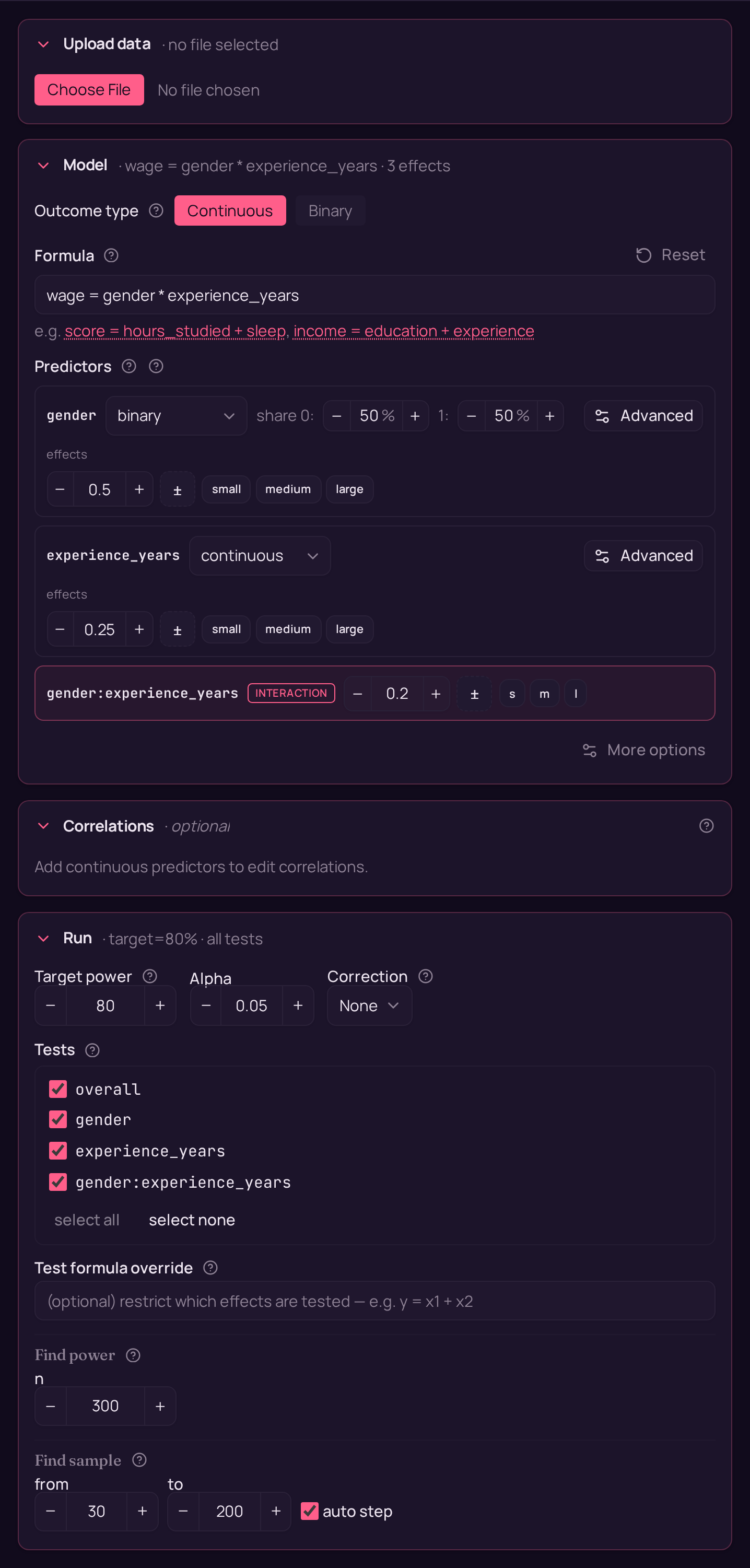
App setup screenshot