Power for an adjusted two-group regression
You are comparing monthly income between union members and non-members, but
you want the comparison to hold years of experience fixed. The question: does
monthly_income differ by union_member once you adjust for experience_years?
This is the ANCOVA / parallel-slopes regression, and as an MCPower formula it
is monthly_income ~ union_member + experience_years — a binary predictor
(union_member) and a continuous predictor (experience_years) entered as
separate main effects, with the two groups sharing a single experience slope.
The power you care about is usually the union_member effect: the group gap
that survives adjustment for experience_years.
Variations
- Swap the covariate's role. If
experience_yearsis the predictor of interest andunion_memberis the nuisance control, nothing in the setup changes — just read power offexperience_yearsinstead ofunion_memberby settingtarget_test="experience_years". - Make the group difference larger or smaller. The
union_member=0.50benchmark is a medium binary effect; drop it to0.20for a small group gap or raise it to0.80for a large one and re-run to see how the required sample size moves. - Add a second continuous control. Append another covariate, e.g.
monthly_income ~ union_member + experience_years + tenure, and give it its own effect — theunion_memberpower then reflects adjustment for both controls. - Let the covariate be a factor instead. Swap the continuous
experience_yearsfor a 3-level factor such assector; the slope term becomes a set of dummy contrasts rather than one coefficient. - Search for N instead of fixing it. Replace
find_powerwithfind_sample_size(target_test="union_member", from_size=50, to_size=400, by=10)to find the smallest N that reaches 80% power on the union gap. - Same design, other fields:
- Clinical:
blood_pressure ~ treatment + baseline_bp— treatment effect on blood pressure adjusting for the patient's baseline measurement. - Ecology:
plant_biomass ~ habitat + rainfall— habitat effect on biomass adjusting for local rainfall.
- Clinical:
Not this setup?
- Group difference where the slope itself differs by group — when the two groups should not share one experience slope.
- A different mix of binary and continuous predictors.
- Sample-size search for a continuous-predictor model.
If you'd rather have…
- Let gender and experience_years interact (gender moderates the experience slope) —
instead of parallel slopes, fit
wage ~ gender * experience_yearsso the experience effect is allowed to differ between the two groups. - Compare the two groups alone (independent t-test) — drop the continuous covariate entirely and just test the group difference.
- Adjust for several continuous controls — when one covariate is not enough and you need to net out a whole block of continuous variables.
- A single continuous predictor, no grouping — when there is no group variable at all and you only have one continuous predictor.
Copy-paste setup
Python setup
from mcpower import MCPower

# Continuous outcome monthly_income on a binary group (union_member) plus a
# continuous covariate (experience_years) — parallel slopes, no interaction.
# This is the ANCOVA/adjusted two-group comparison: the union_member effect is
# the group gap holding experience_years fixed.
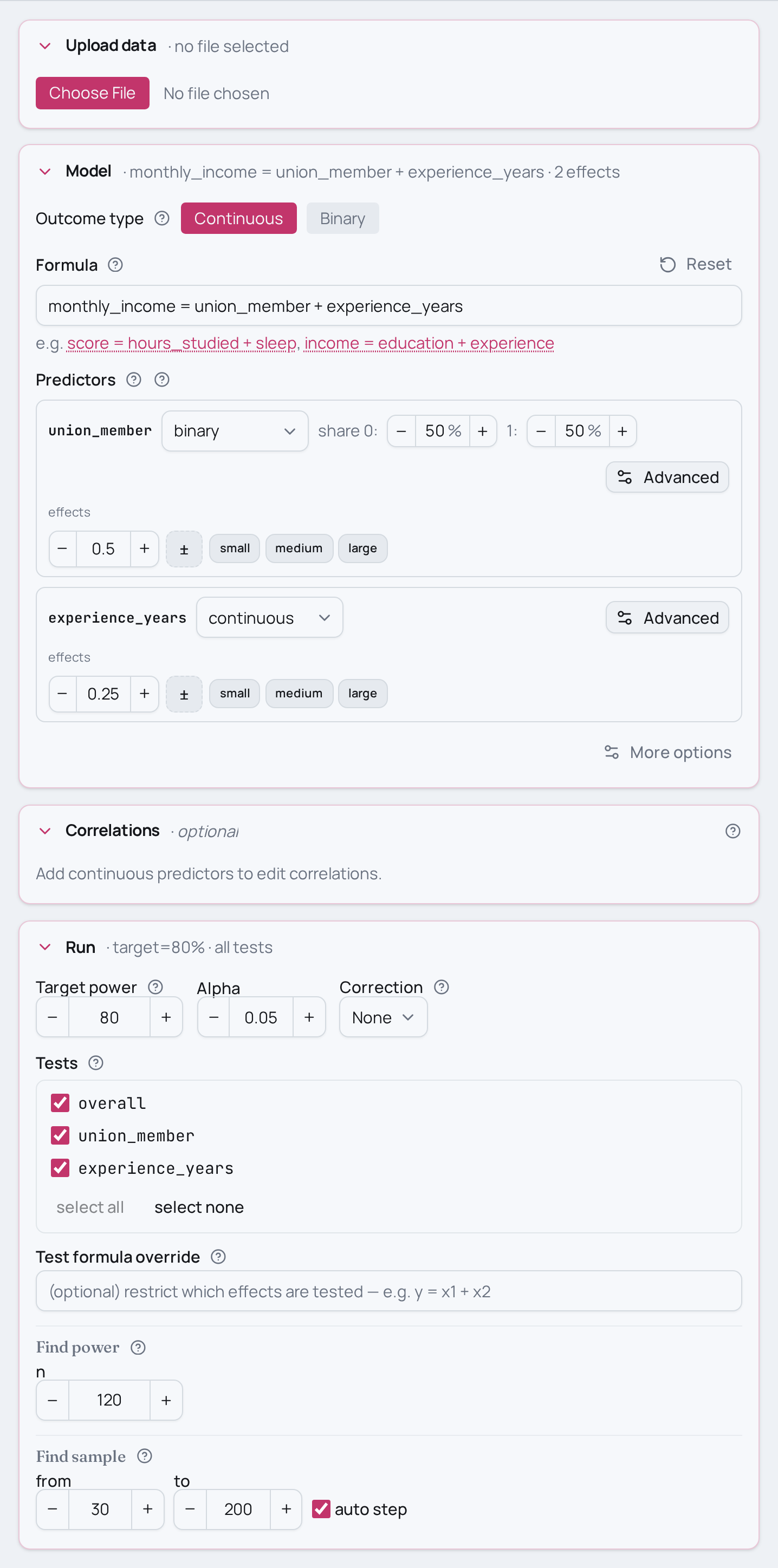
model = MCPower("monthly_income = union_member + experience_years")

# union_member is the binary grouping variable; experience_years stays
# continuous (the default).
model.set_variable_type("union_member=binary")

# Fabricated-plausible effects on the benchmark scale: a medium binary group
# gap (0.50) and a medium continuous experience_years slope (0.25).
model.set_effects("union_member=0.50, experience_years=0.25")

model.find_power(sample_size=120, target_test="all", verbose=False)
R setup
suppressMessages(library(mcpower))

# Continuous outcome monthly_income on a binary group (union_member) plus a
# continuous covariate (experience_years) -- parallel slopes, no interaction.
# This is the ANCOVA/adjusted two-group comparison: the union_member effect is
# the group gap holding experience_years fixed.
model <- MCPower$new("monthly_income ~ union_member + experience_years")

# union_member is the binary grouping variable; experience_years stays
# continuous (the default).
model$set_variable_type("union_member=binary")

# Fabricated-plausible effects on the benchmark scale: a medium binary group
# gap (0.50) and a medium continuous experience_years slope (0.25).
model$set_effects("union_member=0.50, experience_years=0.25")

invisible(model$find_power(sample_size = 120, target_test = "all", verbose = FALSE))
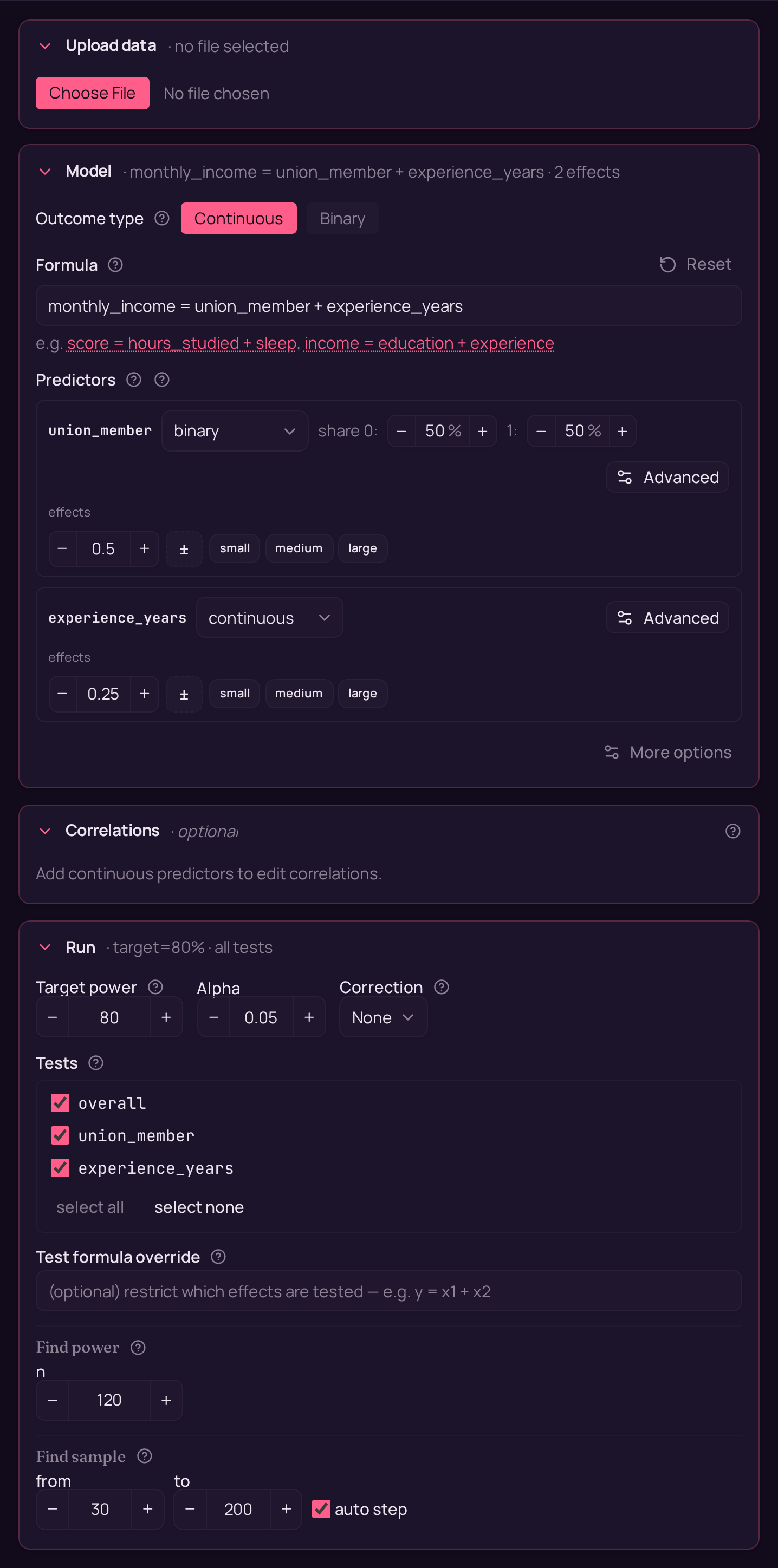
App setup screenshot