Power for two-predictor multiple regression
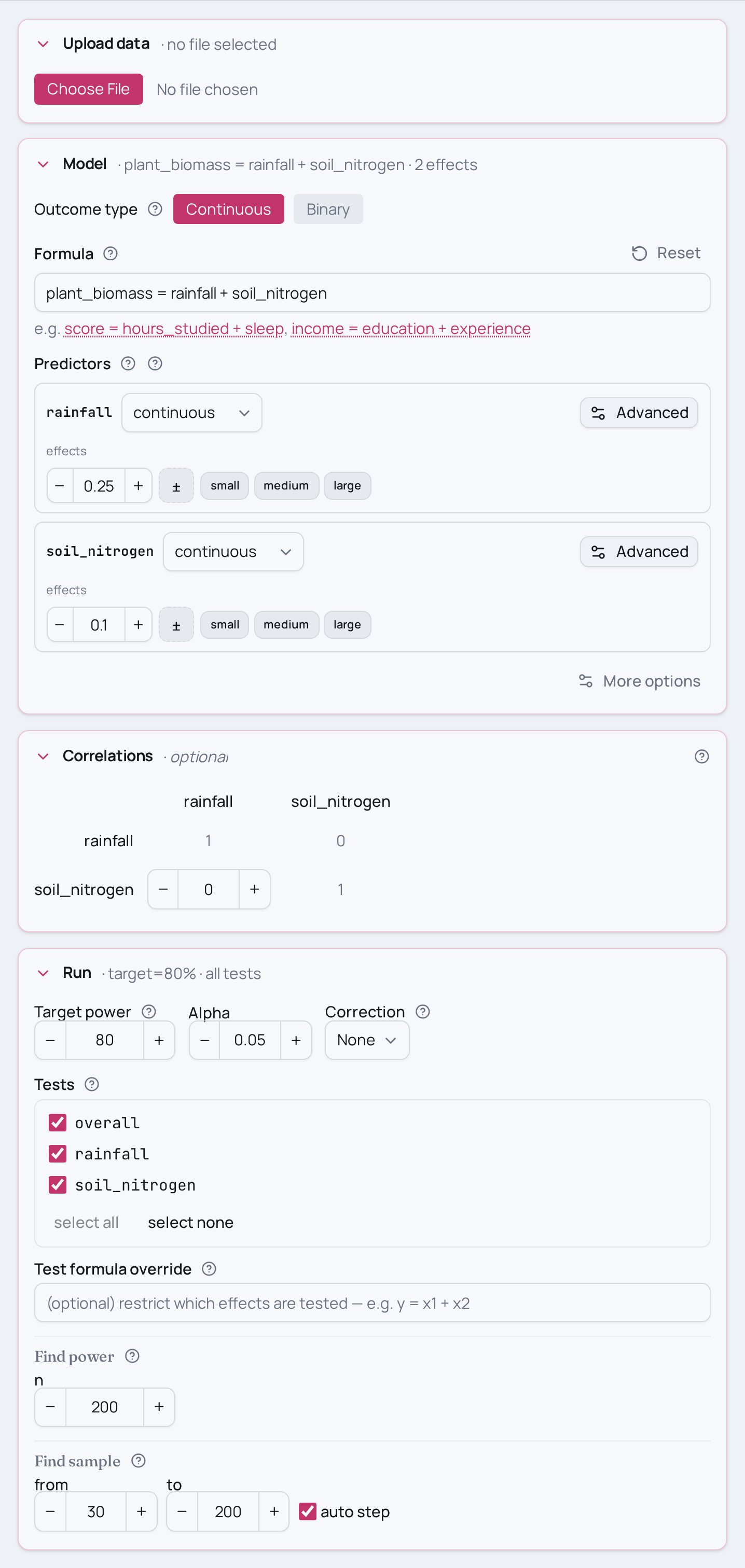
Does annual rainfall predict plant biomass once soil nitrogen is held constant?
Two continuous predictors of a continuous outcome — the classic two-predictor
multiple regression. As an MCPower formula this is
plant_biomass ~ rainfall + soil_nitrogen, fit by ordinary least squares:
rainfall is the predictor of interest, soil_nitrogen a second continuous
variable whose own association you also want enough power to detect.
Variations
- One predictor matters, the other is just a control. Keep
target_test="rainfall"to power only the predictor of interest;soil_nitrogenthen acts as an adjustment covariate you don't need to detect. - Different effect-size guesses. Continuous predictors run on the 0.10 / 0.25 / 0.40 small / medium / large scale — dial each predictor up or down to match your literature estimate.
- Make a predictor categorical. Swap continuous
soil_nitrogenfor a binary group (set_variable_type("soil_nitrogen=binary")) and rescale its effect to the 0.20 / 0.50 / 0.80 binary benchmarks. - Solve for sample size instead of power. Replace
find_power(...)withfind_sample_size(target_test="rainfall, soil_nitrogen", from_size=50, to_size=400)to sweep a grid and report the smallest N that reaches 80% power. - Correlated predictors. If
rainfallandsoil_nitrogenare themselves related, addset_correlations("corr(rainfall, soil_nitrogen)=0.3")so the simulation reflects the collinearity you expect in real data. - Same design, other fields:
- Clinical:
cholesterol ~ dose + age— adjusted effect of dose on cholesterol holding age constant; same two-predictor additive OLS structure. - Social:
wage ~ years_education + experience_years— adjusted wage return to education controlling for experience; same formula shape.
- Clinical:
Not this setup?
- plant_biomass ~ rainfall — a single continuous predictor
- plant_biomass ~ rainfall + soil_nitrogen + temperature — three continuous predictors
- plant_biomass ~ rainfall * soil_nitrogen — two predictors with an interaction
- y ~ group — a single categorical predictor
If you'd rather have…
- Several continuous controls — adds more continuous covariates when you need to adjust an association for several covariates rather than just two predictors.
- Two predictors that interact, plus a covariate — keeps two continuous predictors but lets them interact and adds a covariate; choose this if a moderation effect plus adjustment is what you actually want.
- ANCOVA: a group effect adjusted for a baseline — a group effect adjusted for one continuous baseline covariate, the two-predictor structure where one predictor is categorical.
Copy-paste setup
Python setup
from mcpower import MCPower

# Two continuous predictors of a continuous outcome (OLS).
# rainfall is the predictor of interest; soil_nitrogen is a second continuous covariate
# whose association we also want enough power to detect.
model = MCPower("plant_biomass = rainfall + soil_nitrogen")

# Standardised effect sizes (continuous benchmarks: 0.10 / 0.25 / 0.40).
#   rainfall=0.25 -> a medium association.
#   soil_nitrogen=0.10 -> a small association.
model.set_effects("rainfall=0.25, soil_nitrogen=0.10")

# Both predictors are continuous, so no set_variable_type() is needed.
# OLS defaults apply: 1600 simulations, alpha=0.05, seed=2137.
model.find_power(sample_size=200, target_test="rainfall, soil_nitrogen")
R setup
suppressMessages(library(mcpower))

# Two continuous predictors of a continuous outcome (OLS).
# rainfall is the predictor of interest; soil_nitrogen is a second continuous covariate
# whose association we also want enough power to detect.
model <- MCPower$new("plant_biomass ~ rainfall + soil_nitrogen")

# Standardised effect sizes (continuous benchmarks: 0.10 / 0.25 / 0.40).
#   rainfall=0.25 -> a medium association.
#   soil_nitrogen=0.10 -> a small association.
model$set_effects("rainfall=0.25, soil_nitrogen=0.10")

# Both predictors are continuous, so no set_variable_type() is needed.
# OLS defaults apply: 1600 simulations, alpha=0.05, seed=2137.
invisible(model$find_power(sample_size = 200, target_test = "rainfall, soil_nitrogen"))
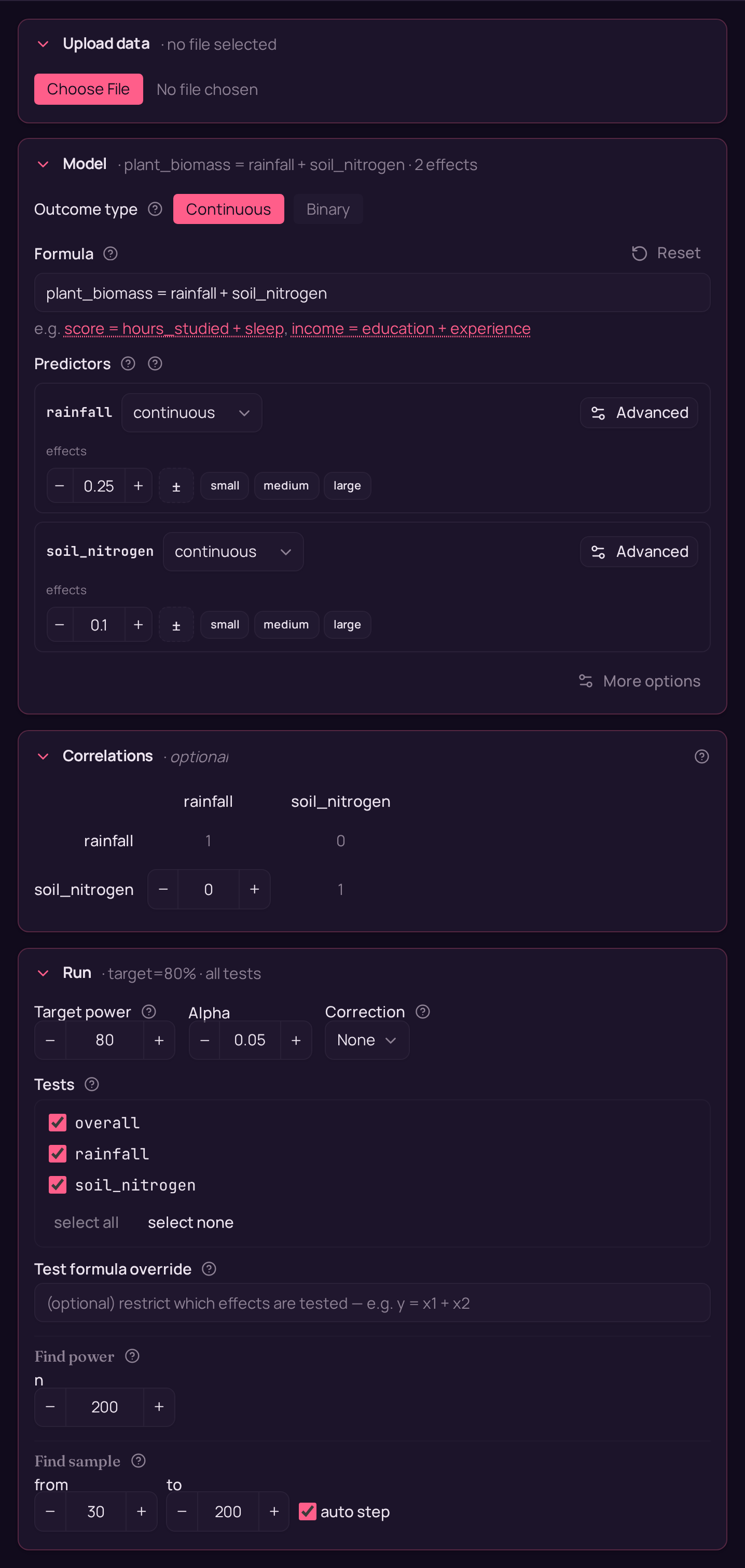
App setup screenshot