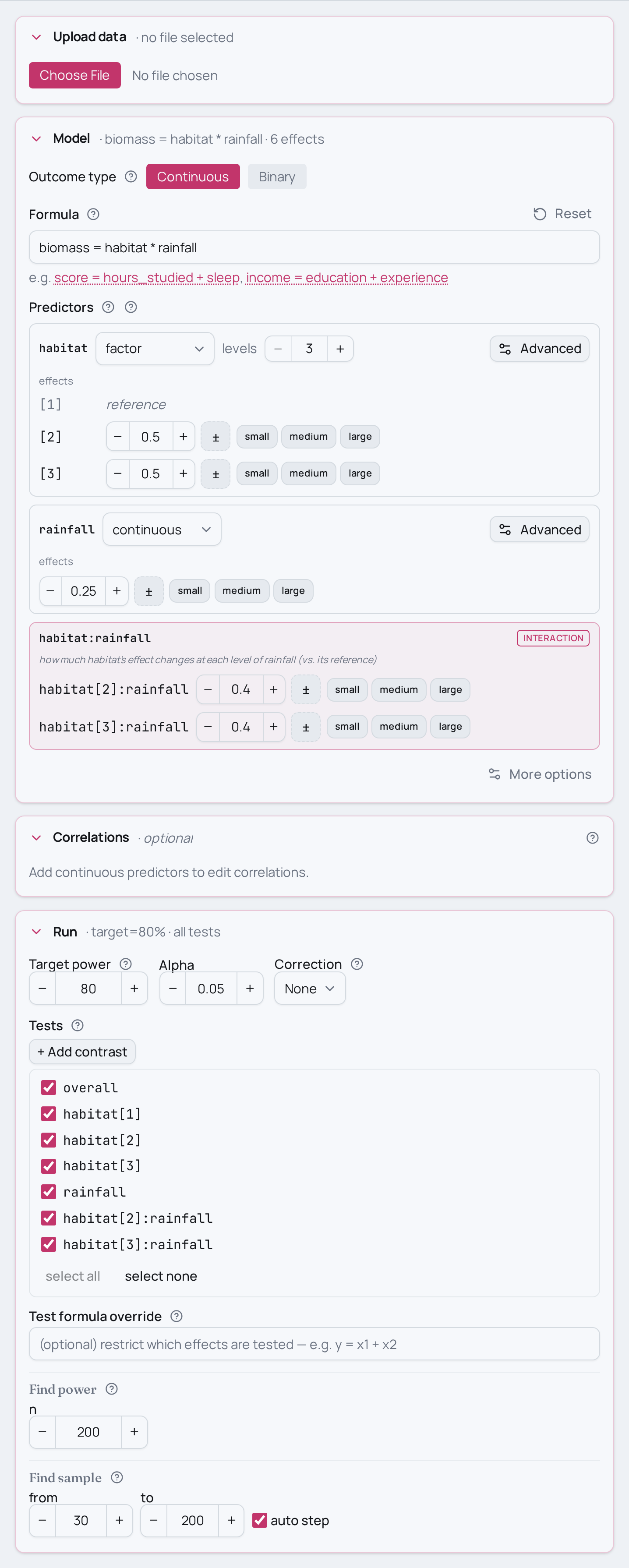
Power for a factor-by-continuous interaction
Three habitat types where you suspect the slope of rainfall on biomass is not
the same in every habitat: rainfall acts on biomass, but you expect that effect
to be stronger or weaker depending on which habitat the sample comes from.
That is a moderation, and in MCPower it is the model biomass ~ habitat * rainfall
— the * expands to the two habitat contrasts, the rainfall slope, and the
habitat:rainfall interaction that carries the moderation. The interaction is the
focal test; with a 3-level habitat it is two dummy-by-rainfall terms (each
non-reference habitat's slope vs the reference habitat's slope).
Variations
- More than three habitat types. Bump
habitat=(factor,4)(or higher) — the interaction grows to one dummy-by-rainfallterm per non-reference level, all tested together when you targethabitat:rainfall. - Swap the continuous moderator for a second factor. Replace
rainfallwith a categorical predictor and declare it as a factor;habitat * groupbecomes a factorial design (a two-way ANOVA written as regression). - Unequal group sizes. If the habitats are not balanced, set the factor level proportions so the design reflects the sampling you actually expect, rather than equal thirds.
- Different moderation strength. The interaction effect (
habitat:rainfall) is the quantity you are usually least sure about — re-run with it at the small (0.10) and large (0.40) continuous benchmarks to bracket how much power hinges on that guess. - Find the N instead of the power. Swap
find_power(sample_size=...)forfind_sample_size(target_test="habitat:rainfall", from_size=..., to_size=...)to get the smallest N that powers the moderation. - Same design, other fields:
- Clinical:
recovery_days ~ dose_level * baseline_severity— does baseline severity moderate the dose-level effect on recovery time across three dose groups? - Social:
wage ~ sector * experience_years— does the experience-years wage slope differ across three employment sectors?
- Clinical:
Not this setup?
- Binary-by-continuous moderation
- Two interacting categorical predictors (factorial as regression)
- ANCOVA with treatment-by-covariate interaction (homogeneity of slopes)
- Continuous-by-continuous moderation (interaction)
If you'd rather have…
- Three-level dummy-coded categorical predictor — same three-level dummy-coded
habitatfactor but as a main effect only, no interaction with a continuous predictor. - Continuous moderation with a covariate — a moderation (interaction) that also adjusts for an additional covariate alongside the interacting predictors.
- Two interacting categorical predictors (factorial as regression) — keep the categorical
habitatpredictor but moderate it by another categorical factor instead of a continuous one (factorial as regression).
Copy-paste setup
Python setup
from mcpower import MCPower

# Three-habitat study with a continuous moderator.
# Research question: does the effect of rainfall on biomass differ across the
# three habitat types -- i.e. does habitat moderate the rainfall slope?
# '*' expands habitat * rainfall to habitat + rainfall + habitat:rainfall.
model = MCPower("biomass = habitat * rainfall")

# habitat is a categorical predictor with 3 levels -> 2 dummy contrasts;
# rainfall is continuous (left at its default standardised distribution).
model.set_variable_type("habitat=(factor,3)")

# A 3-level factor expands to per-level dummies, so its effects and the
# interaction are named per level: habitat[2], habitat[3], and
# habitat[2]:rainfall, habitat[3]:rainfall (the bare names habitat / habitat:rainfall
# do not exist after expansion).
# Standardised effects:
#   habitat[2]=habitat[3]=0.5 -> factor benchmark (0.20/0.50/0.80), each
#                                 non-reference level shifts the outcome by
#                                 a medium amount.
#   rainfall=0.25              -> continuous benchmark (0.10/0.25/0.40), a
#                                 medium slope.
#   habitat[*]:rainfall=0.4   -> the moderation: how much each habitat's
#                                 rainfall slope departs from the reference slope.
model.set_effects(
    "habitat[2]=0.5, habitat[3]=0.5, rainfall=0.25, "
    "habitat[2]:rainfall=0.4, habitat[3]:rainfall=0.4"
)

# Power at N=200 for the interaction dummies -- the moderation is the focal test.
model.find_power(sample_size=200, target_test="habitat[2]:rainfall, habitat[3]:rainfall")
R setup
suppressMessages(library(mcpower))

# Three-habitat study with a continuous moderator.
# Research question: does the effect of rainfall on biomass differ across the
# three habitat types -- i.e. does habitat moderate the rainfall slope?
# '*' expands habitat * rainfall to habitat + rainfall + habitat:rainfall.
model <- MCPower$new("biomass ~ habitat * rainfall")

# habitat is a categorical predictor with 3 levels -> 2 dummy contrasts;
# rainfall is continuous (left at its default standardised distribution).
model$set_variable_type("habitat=(factor,3)")

# A 3-level factor expands to per-level dummies, so its effects and the
# interaction are named per level: habitat[2], habitat[3], and
# habitat[2]:rainfall, habitat[3]:rainfall (the bare names habitat / habitat:rainfall
# do not exist after expansion).
# Standardised effects:
#   habitat[2]=habitat[3]=0.5 -> factor benchmark (0.20/0.50/0.80), each
#                                 non-reference level shifts the outcome by
#                                 a medium amount.
#   rainfall=0.25              -> continuous benchmark (0.10/0.25/0.40), a
#                                 medium slope.
#   habitat[*]:rainfall=0.4   -> the moderation: how much each habitat's
#                                 rainfall slope departs from the reference slope.
model$set_effects(paste0(
  "habitat[2]=0.5, habitat[3]=0.5, rainfall=0.25, ",
  "habitat[2]:rainfall=0.4, habitat[3]:rainfall=0.4"
))

# Power at N=200 for the interaction dummies -- the moderation is the focal test.
invisible(model$find_power(
  sample_size = 200,
  target_test = "habitat[2]:rainfall, habitat[3]:rainfall"
))
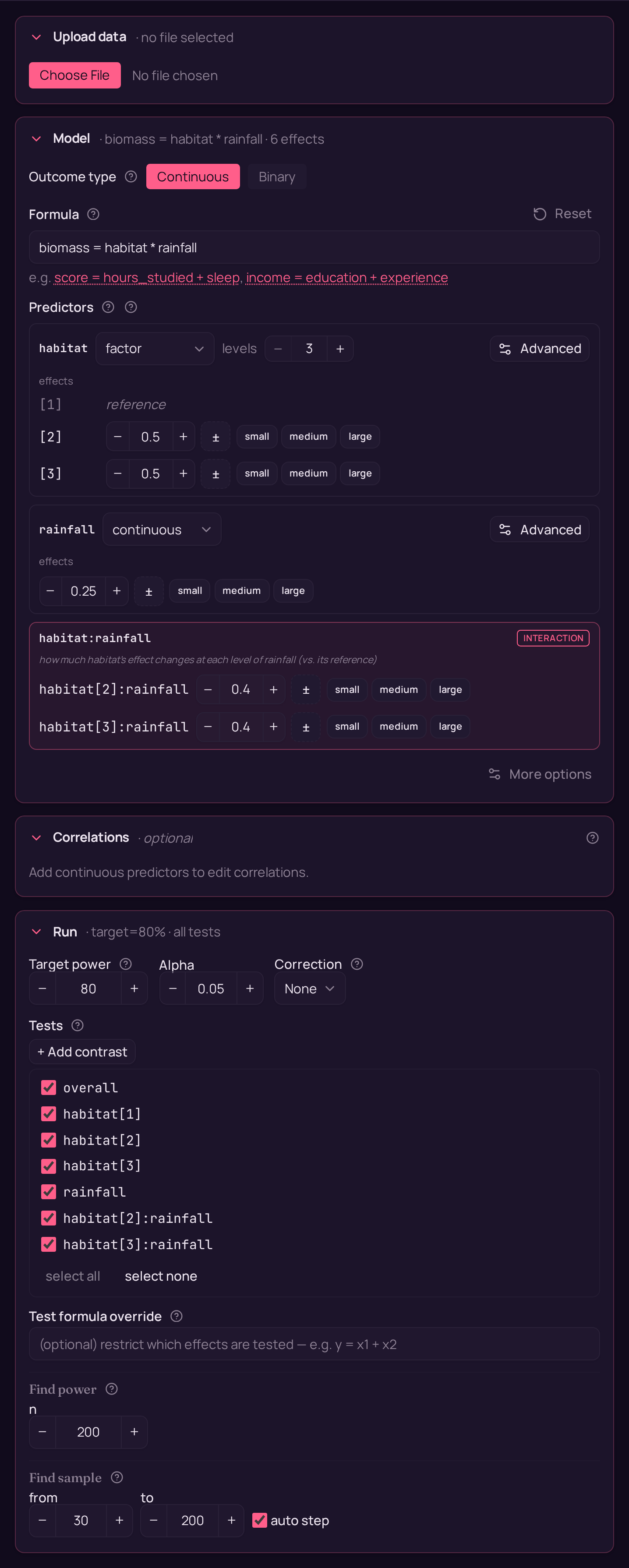
App setup screenshot