Power for a categorical (factor) predictor
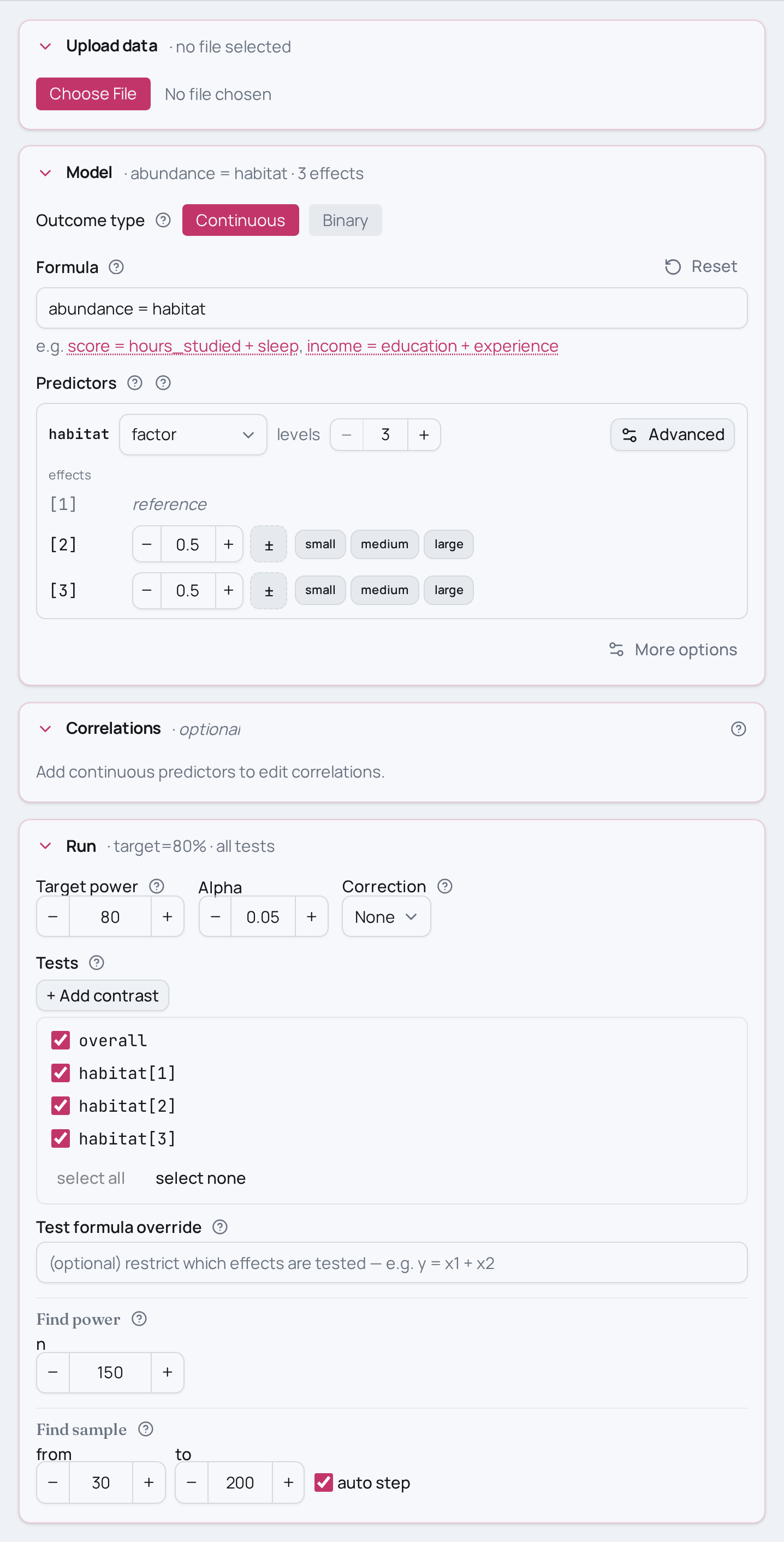
You surveyed species abundance across three habitat types (forest, grassland, and wetland) and want the power to detect that some habitats differ from the reference in abundance, read off the individual dummy coefficients rather than a single omnibus verdict.
As an MCPower model this is abundance ~ habitat, where habitat is a 3-level
factor. OLS expands it into two dummy contrasts, each comparing a non-reference
habitat against the reference habitat, and reports power for each contrast
separately.
Variations
- More than three habitats. Bump the factor to its real level count —
habitat=(factor,4)for a four-habitat design. Each extra level adds one more dummy contrast (and one more row of power) against the same reference. - Unequal expected effects per habitat. Setting both to
0.5puts the same shift on every non-reference level. To say one habitat differs more strongly, set the level effects apart:habitat[2]=0.3, habitat[3]=0.7. - A covariate to soak up noise. Add a continuous control, e.g.
abundance ~ habitat + rainfall, withrainfallon the continuous benchmark scale (rainfall=0.25) — an analysis-of-covariance flavour that usually lifts power on thehabitatcontrasts. - Search for the N instead of fixing it. Swap the
find_powercall forfind_sample_size(target_test="habitat[2], habitat[3]", from_size=50, to_size=400, by=10)to get the smallest N that reaches target power on both contrasts. - Same design, other fields:
- Clinical:
pain_score ~ dose_level— pain score compared across three dose levels (placebo, low, and high), withdose_level=(factor,3). - Social science:
job_satisfaction ~ sector— job satisfaction compared across three employment sectors (public, private, and nonprofit), withsector=(factor,3).
- Clinical:
Not this setup?
- Two groups instead of three
- The omnibus F-test of overall group differences
- A group factor interacting with a continuous predictor
If you'd rather have…
- ols/ols-07 — Only two groups instead of three: an independent t-test recast as regression with a single dummy.
- anova/anova-01 — Same 3+ group structure, but you want the omnibus F-test of overall group differences rather than per-dummy coefficients.
- anova/anova-02 — Three-level group factor where you also want all pairwise post-hoc comparisons, not just the dummy contrasts vs the reference.
- ols/ols-14 — Same dummy-coded factor but interacting with a continuous predictor (moderation).
- ols/ols-15 — Two categorical predictors interacting: a factorial design as regression.
- glm/glm-03 — Same multi-level categorical predictor but on a binary outcome (logistic).
Copy-paste setup
Python setup
from mcpower import MCPower

# Three habitat types: one continuous outcome, one 3-level grouping factor.
# Research question: do the habitat types differ on species abundance,
# tested as the two dummy contrasts against the reference habitat?
model = MCPower("abundance = habitat")

# habitat is a categorical predictor with 3 levels -> 2 dummy contrasts.
model.set_variable_type("habitat=(factor,3)")

# Standardised effects on the factor benchmark scale (0.20 / 0.50 / 0.80):
# each non-reference level shifts the outcome by a medium amount vs reference.
# Factors expand to per-level dummies (habitat[2], habitat[3]); effects
# and targets are addressed by those dummy names, not the bare factor.
model.set_effects("habitat[2]=0.5, habitat[3]=0.5")

# Power at N=150 for both dummy contrasts (each non-reference level vs reference).
model.find_power(sample_size=150, target_test="habitat[2], habitat[3]")
R setup
suppressMessages(library(mcpower))

# Three habitat types: one continuous outcome, one 3-level grouping factor.
# Research question: do the habitat types differ on species abundance,
# tested as the two dummy contrasts against the reference habitat?
model <- MCPower$new("abundance ~ habitat")

# habitat is a categorical predictor with 3 levels -> 2 dummy contrasts.
model$set_variable_type("habitat=(factor,3)")

# Standardised effects on the factor benchmark scale (0.20 / 0.50 / 0.80):
# each non-reference level shifts the outcome by a medium amount vs reference.
# Factors expand to per-level dummies (habitat[2], habitat[3]); effects
# and targets are addressed by those dummy names, not the bare factor.
model$set_effects("habitat[2]=0.5, habitat[3]=0.5")

# Power at N=150 for both dummy contrasts (each non-reference level vs reference).
invisible(model$find_power(sample_size = 150, target_test = "habitat[2], habitat[3]"))
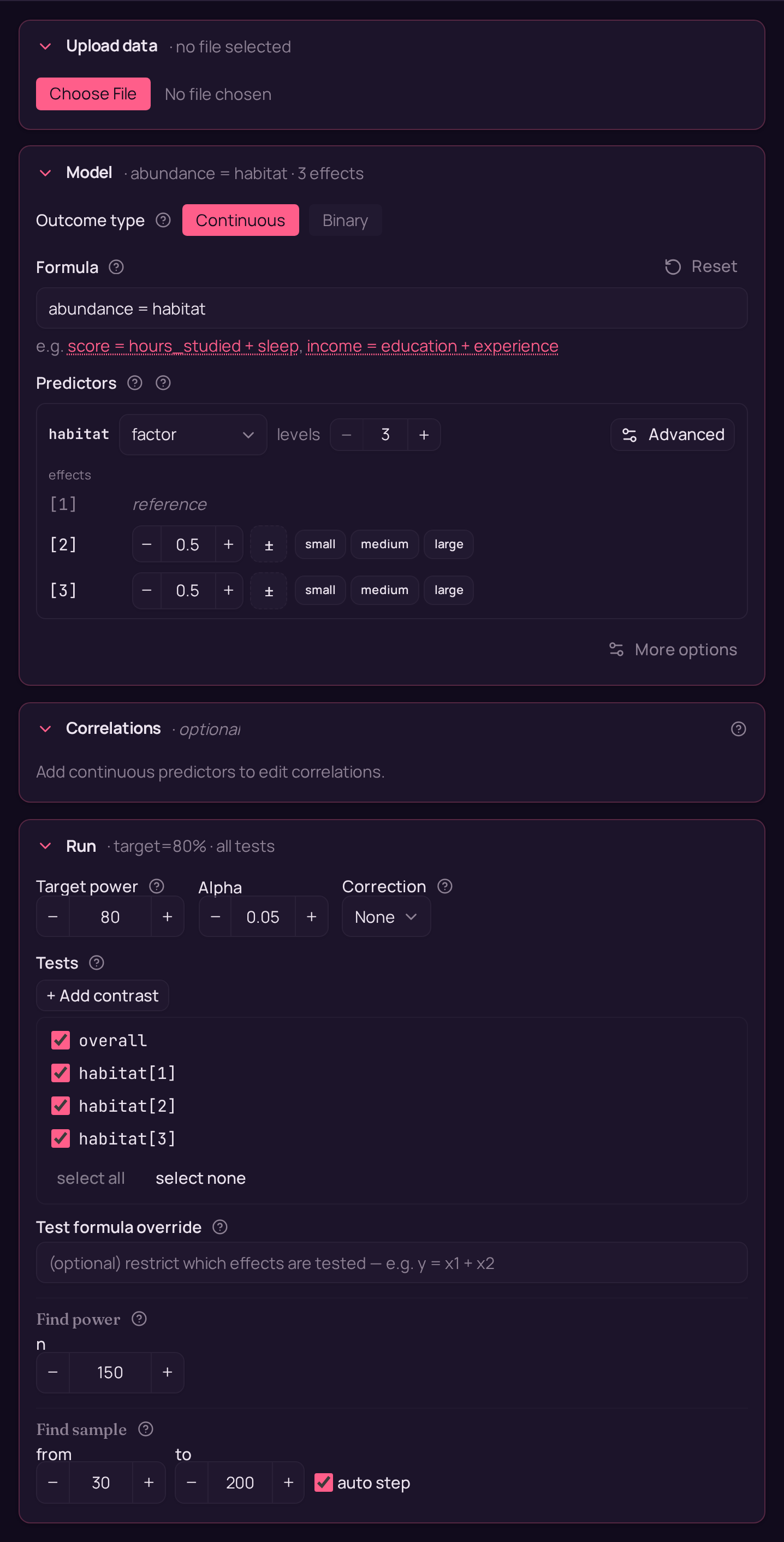
App setup screenshot