Power for a 2x2 factorial interaction
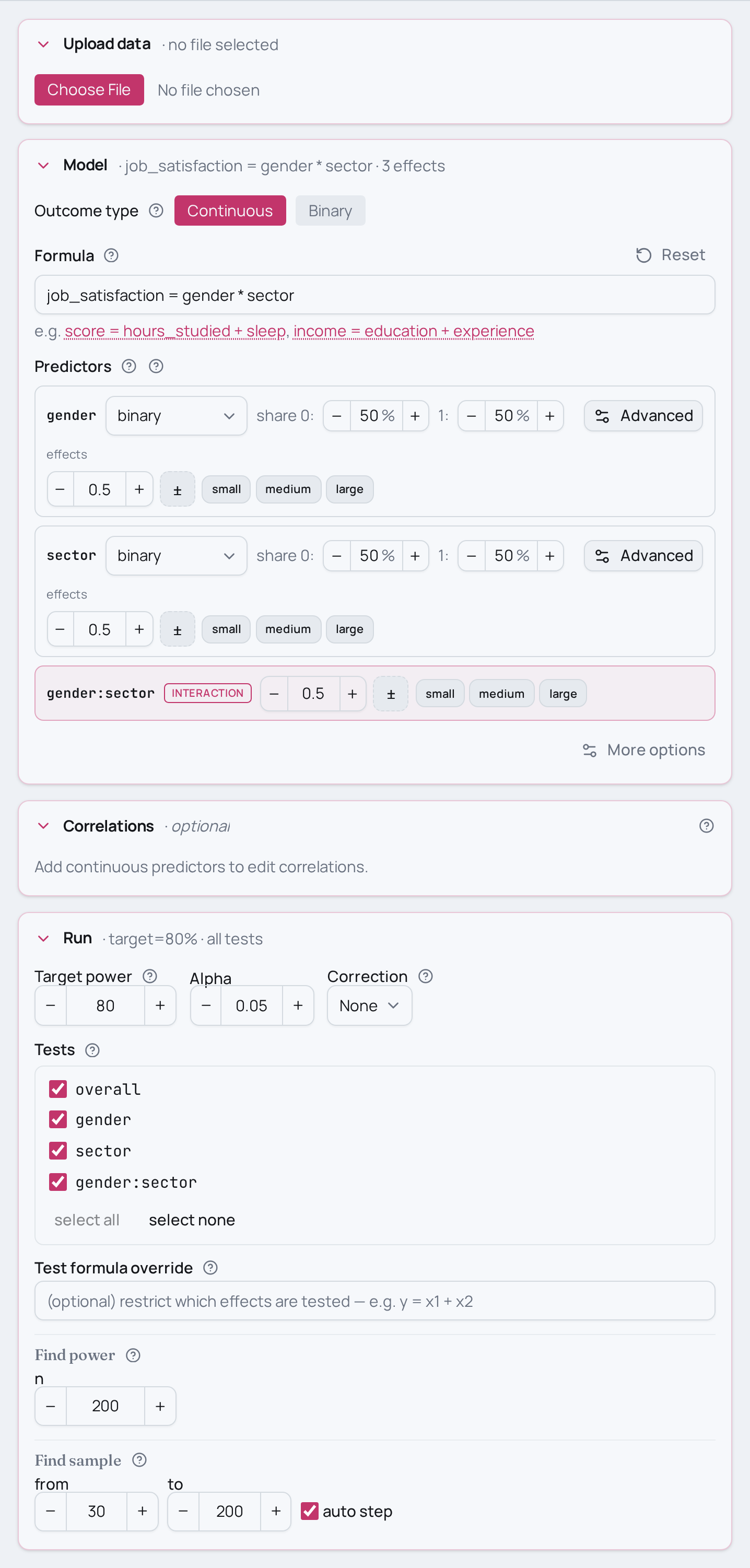
You ran a study that crosses two two-level factors — gender fully crossed with
sector — and the question that motivated the design is not either main effect
but whether they interact: does the effect of gender on job satisfaction differ
by sector, or equivalently does the effect of sector differ by gender? That is the
classic 2x2 factorial interaction, the difference in cell differences.
As an MCPower formula this is job_satisfaction ~ gender * sector, where *
expands to gender + sector + gender:sector. Both gender and sector are
two-level factors; the test of interest is the interaction term gender:sector.
Variations
- Search for the N you need instead of scoring one design: swap
find_power(sample_size=200, …)forfind_sample_size(target_test="gender:sector", from_size=100, to_size=600, by=25). A 2x2 interaction needs markedly more N than either main effect, so set the upper bound generously. - Test the main effects too by setting
target_test="gender"(ortarget_test="all"for every term plus the omnibus), if you also care about the average effects, not only the interaction. - Stronger or weaker moderation: move
gender:sectoracross the factor benchmarks — 0.20 (subtle), 0.50 (medium), 0.80 (the two groups respond very differently) — to see how fast power for the interaction collapses as the effect shrinks. - A wider design: give one factor three or more levels with
set_variable_type("sector=(factor,3)")— the interaction then spans several contrasts and demands still more N. - Same design, other fields:
- Clinical:
pain_score ~ treatment * site— does treatment effectiveness differ across clinical sites? - Ecology:
abundance ~ habitat * nitrogen— does the nitrogen effect on species abundance differ between habitat types?
- Clinical:
Not this setup?
- Dummy-coded factor interacting with a continuous predictor
- Two-way factorial ANOVA with interaction (2x2 / 2x3 / 3x3 / 2x4)
- ANCOVA with treatment-by-covariate interaction (homogeneity of slopes)
If you'd rather have…
- Dummy-coded factor interacting with a continuous predictor — One of the two factors becomes a continuous moderator: gender (factor) interacting with a continuous predictor instead of a second factor.
- Two-way factorial ANOVA with interaction (2x2 / 2x3 / 3x3 / 2x4) — Same 2-factor factorial design analyzed as a two-way ANOVA with omnibus F-tests for the interaction rather than dummy-coded regression coefficients.
- ANCOVA with treatment-by-covariate interaction (homogeneity of slopes) — Replace the second categorical factor with a continuous covariate: gender x baseline (ANCOVA, homogeneity-of-slopes) keeps the factor-by-X interaction shape.
- Logistic factor-by-factor interaction (2x2) — Same factor-by-factor (2x2) interaction but on a binary outcome via logistic regression.
- Three-level dummy-coded categorical predictor — Drop to a single multi-level categorical predictor (no interaction) if you only need one factor's main effect.
Copy-paste setup
Python setup
from mcpower import MCPower

# 2x2 factorial: does the effect of `gender` depend on `sector`? '*' expands
# gender * sector to gender + sector + gender:sector, so the interaction
# (the difference in cell differences) is fitted explicitly.
model = MCPower("job_satisfaction = gender * sector")

# Both predictors are two-level factors: gender and sector.
model.set_variable_type("gender=binary, sector=binary")

# Effect sizes on the factor benchmark scale (0.20 / 0.50 / 0.80):
#   gender=0.50         -> medium main effect of gender.
#   sector=0.50         -> medium main effect of sector.
#   gender:sector=0.50  -> medium interaction (the moderation effect).
model.set_effects("gender=0.50, sector=0.50, gender:sector=0.50")

model.set_seed(2137)

# Power for the interaction (the 2x2 cell-difference test) at N=200.
model.find_power(sample_size=200, target_test="gender:sector")
R setup
suppressMessages(library(mcpower))

# 2x2 factorial: does the effect of `gender` depend on `sector`? '*' expands
# gender * sector to gender + sector + gender:sector, so the interaction
# (the difference in cell differences) is fitted explicitly.
model <- MCPower$new("job_satisfaction ~ gender * sector")

# Both predictors are two-level factors: gender and sector.
model$set_variable_type("gender=binary, sector=binary")

# Effect sizes on the factor benchmark scale (0.20 / 0.50 / 0.80):
#   gender=0.50          -> medium main effect of gender.
#   sector=0.50          -> medium main effect of sector.
#   gender:sector=0.50   -> medium interaction (the moderation effect).
model$set_effects("gender=0.50, sector=0.50, gender:sector=0.50")

model$set_seed(2137)

# Power for the interaction (the 2x2 cell-difference test) at N=200.
invisible(model$find_power(sample_size = 200, target_test = "gender:sector"))
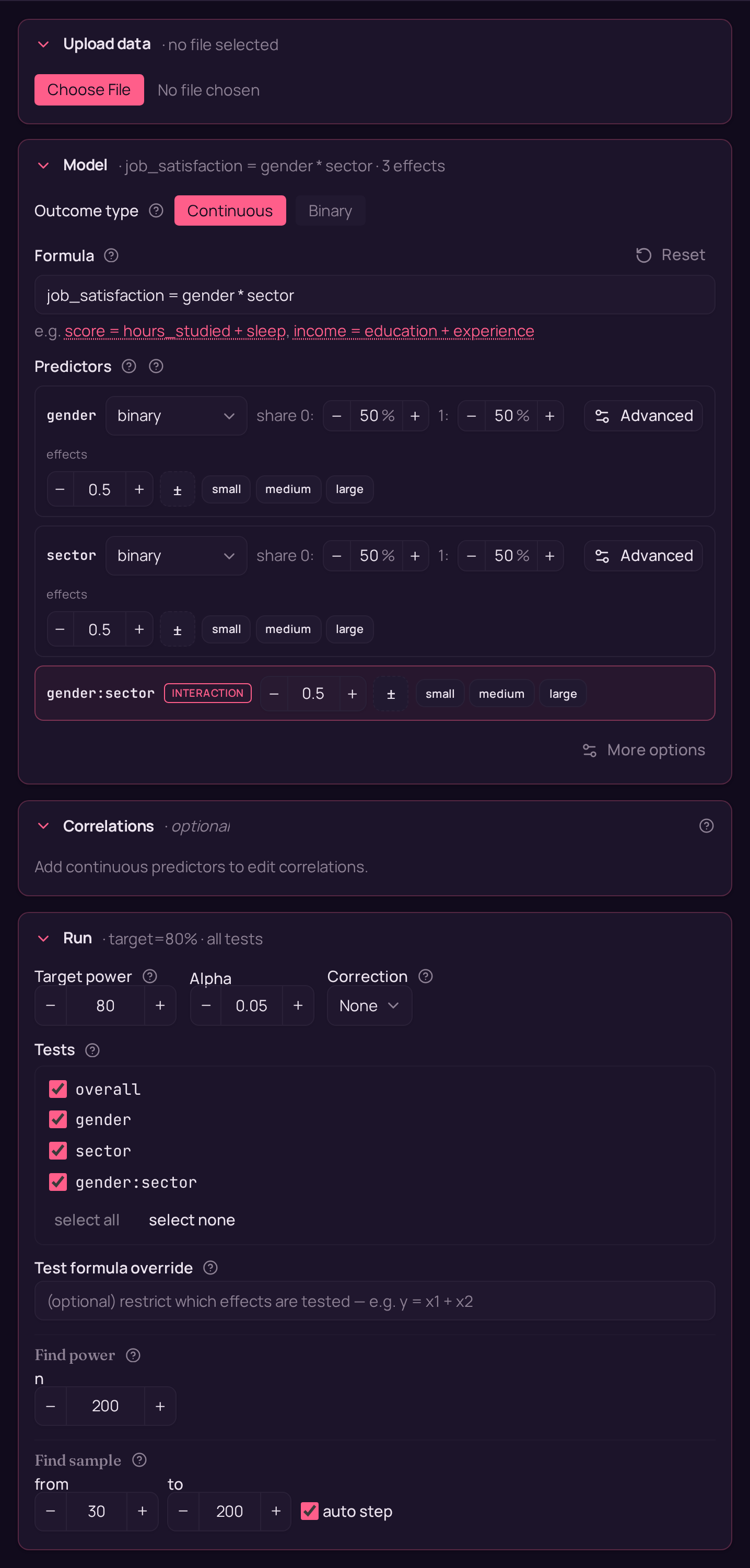
App setup screenshot