Power for a two-way factorial ANOVA interaction
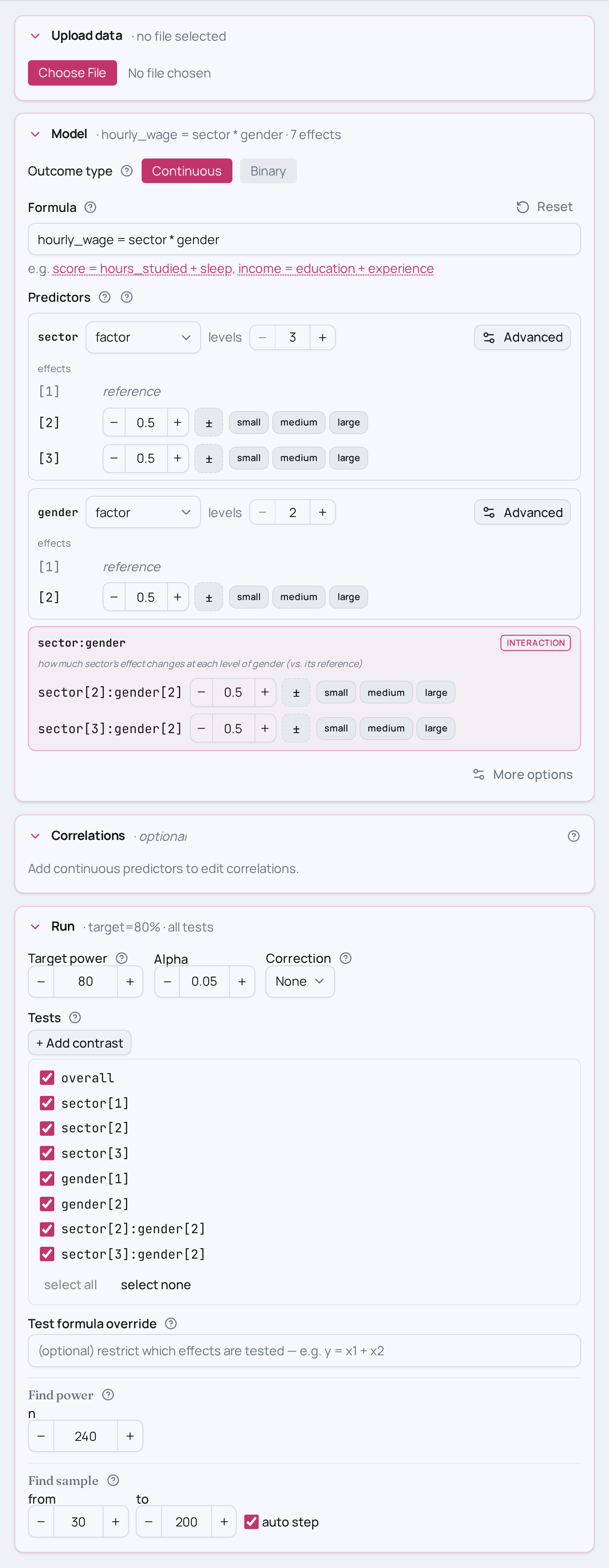
You collected wages from workers across three employment sectors (e.g. public, private, non-profit) and two gender categories, with every combination of sector and gender represented in your sample. Beyond each factor's own wage gap, the headline question is the interaction: does the sector wage premium depend on gender?
As an MCPower model this is hourly_wage = sector * gender. The * expands to
sector + gender + sector:gender, so OLS fits both main effects and the
interaction. With a 3-level sector and a 2-level gender factor the design has six
cells; the interaction is carried by the cell-difference contrasts, and power is
reported for each.
Variations
- A balanced 2x2 design. Drop
sectorto two levels (sector=(factor,2)) so the interaction collapses to a single cell-difference contrast — the classic 2x2 factorial. - Larger grids. Bump either factor to its real level count (e.g.
sector=(factor,4)); each extra level adds dummy contrasts to that main effect and to the interaction. - Test a main effect instead. Point
target_testatsector(orgender) to read power for a main-effect's contrasts rather than the interaction. - Unequal effects across levels. A single
sector=0.50puts the same shift on every non-reference level; set the level effects apart when one sector is expected to move wages more than another. - Search for the N instead of fixing it. Swap the
find_powercall forfind_sample_size(target_test="sector:gender", from_size=60, to_size=400, by=10)to get the smallest N that reaches target power on the interaction contrasts. - Same design, other fields:
blood_pressure = treatment * sex— clinical: interaction between treatment arm (3 levels) and patient sexbiomass = fertilizer * habitat— ecology: interaction between fertilizer (3 levels) and habitat type
Not this setup?
- A third factor: three-way (2x2x2) factorial ANOVA
- The same two factors plus a continuous covariate (ANCOVA)
- The same two interacting factors framed as regression
If you'd rather have…
- anova/anova-05 — Add a third factor: three-way factorial ANOVA (2x2x2) with all main effects and interactions.
- anova/anova-06 — Keep the two-way factorial but adjust for a continuous covariate (factorial ANCOVA).
- anova/anova-01 — Drop to a single factor: one-way ANOVA omnibus across 3+ groups.
- ols/ols-15 — Same two interacting categorical predictors framed as a regression rather than an ANOVA.
Copy-paste setup
Python setup
from mcpower import MCPower

# Two-way factorial ANOVA: hourly wage crossed by employment sector and gender.
# Research question -- does the sector wage gap depend on gender? -> the interaction.
# '*' expands sector * gender to sector + gender + sector:gender, so
# both main effects and the interaction are fitted explicitly.
model = MCPower("hourly_wage = sector * gender")

# sector has 3 levels -> 2 dummy contrasts; gender has 2 levels -> 1 dummy.
# The interaction therefore contributes 2 cell-difference contrasts.
model.set_variable_type("sector=(factor,3), gender=(factor,2)")

# Effects are assigned per dummy contrast, not per base factor name: with no
# uploaded data the levels are integer-labelled, level 1 is the reference, and
# the expansion produces exactly these five terms. All on the factor benchmark
# scale (0.20 / 0.50 / 0.80) at medium = 0.50:
#   sector[2], sector[3]                -> sector's two main contrasts.
#   gender[2]                           -> gender's main contrast.
#   sector[2]:gender[2], sector[3]:gender[2] -> the two interaction cells.
model.set_effects(
    "sector[2]=0.50, sector[3]=0.50, gender[2]=0.50, "
    "sector[2]:gender[2]=0.50, sector[3]:gender[2]=0.50"
)

model.set_seed(2137)

# Power for one interaction cell -- the factorial design's focal test -- at
# N=240. (target_test names a single expanded effect; there is no bare
# 'sector:gender' term after dummy expansion.)
model.find_power(sample_size=240, target_test="sector[2]:gender[2]")
R setup
suppressMessages(library(mcpower))

# Two-way factorial ANOVA: hourly wage crossed by employment sector and gender.
# Research question -- does the sector wage gap depend on gender? -> the interaction.
# '*' expands sector * gender to sector + gender + sector:gender, so
# both main effects and the interaction are fitted explicitly.
model <- MCPower$new("hourly_wage ~ sector * gender")

# sector has 3 levels -> 2 dummy contrasts; gender has 2 levels -> 1 dummy.
# The interaction therefore contributes 2 cell-difference contrasts.
model$set_variable_type("sector=(factor,3), gender=(factor,2)")

# Effects are assigned per dummy contrast, not per base factor name: with no
# uploaded data the levels are integer-labelled, level 1 is the reference, and
# the expansion produces exactly these five terms. All on the factor benchmark
# scale (0.20 / 0.50 / 0.80) at medium = 0.50:
#   sector[2], sector[3]                -> sector's two main contrasts.
#   gender[2]                           -> gender's main contrast.
#   sector[2]:gender[2], sector[3]:gender[2] -> the two interaction cells.
model$set_effects(
  paste0(
    "sector[2]=0.50, sector[3]=0.50, gender[2]=0.50, ",
    "sector[2]:gender[2]=0.50, sector[3]:gender[2]=0.50"
  )
)

model$set_seed(2137)

# Power for one interaction cell -- the factorial design's focal test -- at
# N=240. (target_test names a single expanded effect; there is no bare
# 'sector:gender' term after dummy expansion.)
invisible(model$find_power(sample_size = 240, target_test = "sector[2]:gender[2]"))
App setup screenshot