Power for a three-way factorial ANOVA (2x2x2)
You ran a fully crossed greenhouse experiment with three binary growth factors — watering level, nitrogen supplementation, and light intensity — so each plot lands in one cell of a 2x2x2 design, and you measured seed yield per plot. Beyond each factor's own effect and each pair's interaction, you want the power to detect the three-way interaction: the way the watering-by-nitrogen pattern itself changes across light levels.
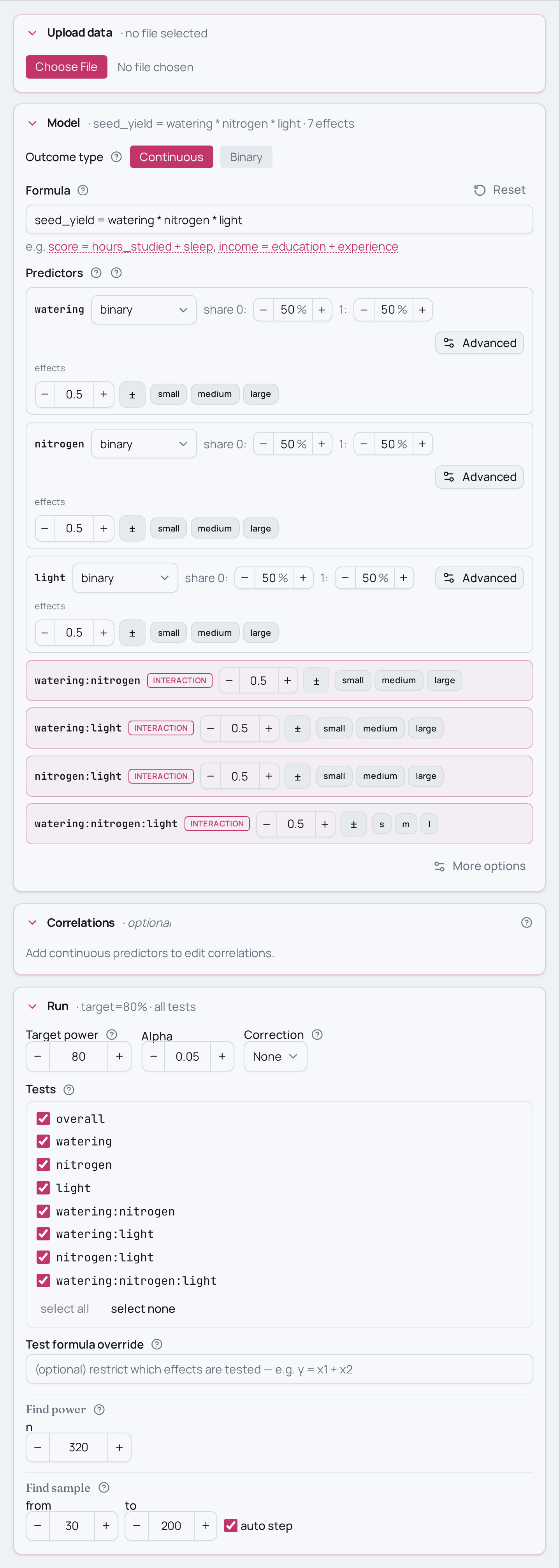
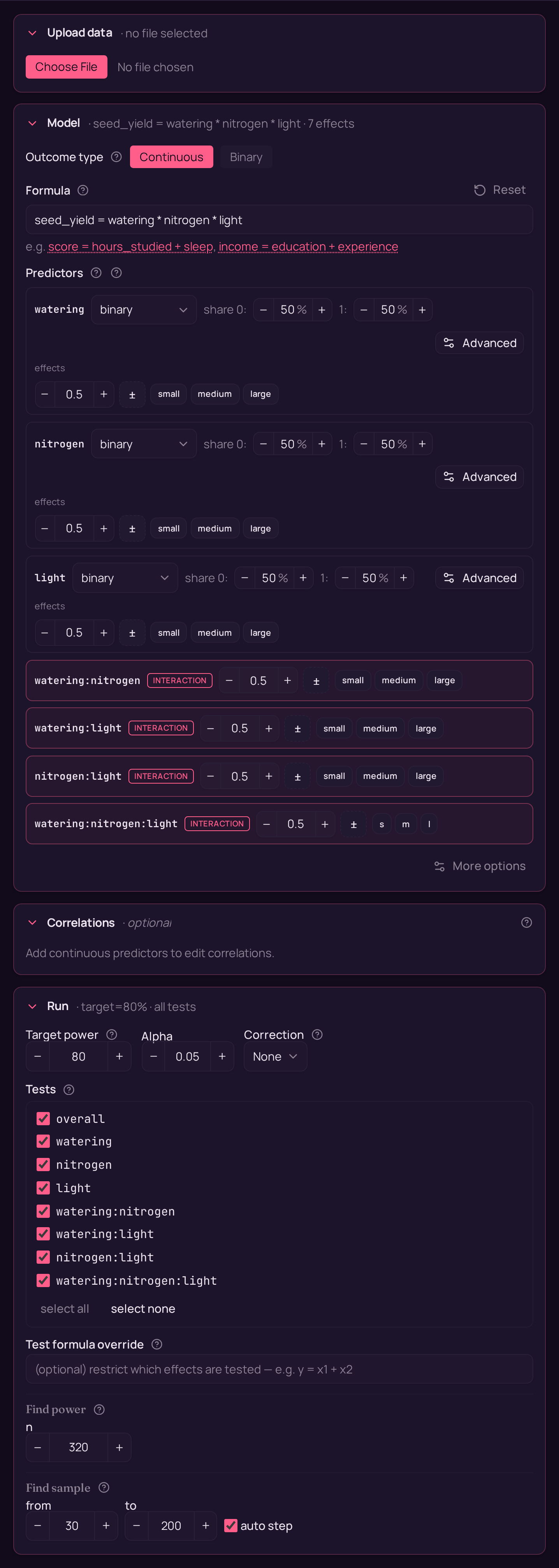
As an MCPower model this is seed_yield = watering * nitrogen * light, all
three two-level binary factors. The * expands to every main effect, all three
pairwise interactions, and the top-level watering:nitrogen:light term, so the
whole factorial is fitted at once; here you read power off that highest-order
interaction.
Variations
- More levels per factor. A factor need not be two-level — set, say,
nitrogen=(factor,3)for a 2x2x3 design. Each extra level multiplies the number of cells and the dummy contrasts the three-way term spans, so power for the same effect size usually drops. - Test a different term. Swap the
target_testto a pairwise interaction (watering:nitrogen) or a main effect (watering) if that, not the three-way term, is the hypothesis you're powering for. - Unequal expected effects. A single
0.50puts the same shift on every term. To say the three-way interaction is weaker than the main effects — the usual reality — set it smaller (e.g.watering:nitrogen:light=0.20) and watch how much more N the higher-order term demands. - Search for the N instead of fixing it. Swap the
find_powercall forfind_sample_size(target_test="watering:nitrogen:light", from_size=100, to_size=600, by=20)to get the smallest N that reaches target power on the three-way interaction. - Same design, other fields:
blood_pressure = treatment * sex * age_group— clinical: three-way interaction of treatment arm, sex, and age categoryjob_satisfaction = sector * gender * union_member— social science: three-way interaction of sector, gender, and union membership
Not this setup?
- Drop one factor: a two-way factorial ANOVA
- Factorial ANOVA that also adjusts for a covariate
- A single one-way omnibus ANOVA across 3+ groups
If you'd rather have…
- anova/anova-04 — Drop to a two-way factorial ANOVA (2x2 / 2x3 / 3x3 / 2x4) if a three-way design is more than you need.
- anova/anova-06 — Two-way factorial ANOVA that also adjusts for a continuous covariate (factorial ANCOVA).
- anova/anova-01 — A single one-way omnibus ANOVA across 3+ groups, the simplest factor design.
- ols/ols-05 — The same three-way interaction structure but with continuous predictors instead of factors (OLS).
- glm/glm-08 — Three-way interaction recast for a binary outcome via logistic GLM.
Copy-paste setup
Python setup
from mcpower import MCPower

# Three-way factorial ANOVA: seed yield crossed by three binary growth factors.
# Research question: does the watering-by-nitrogen interaction itself shift
# across light levels? -> the three-way watering:nitrogen:light interaction.
# '*' expands watering * nitrogen * light to all main effects, all pairwise
# interactions, and the three-way term, so every cell of the design is fitted.
model = MCPower("seed_yield = watering * nitrogen * light")

# All three predictors are two-level factors (a 2x2x2 design).
model.set_variable_type("watering=binary, nitrogen=binary, light=binary")

# Effect sizes on the factor benchmark scale (0.20 / 0.50 / 0.80):
#   main effects 0.50                 -> medium shift per factor.
#   two-way interactions 0.50         -> medium moderation between each pair.
#   watering:nitrogen:light=0.50      -> medium three-way interaction (the target).
model.set_effects(
    "watering=0.50, nitrogen=0.50, light=0.50, "
    "watering:nitrogen=0.50, watering:light=0.50, nitrogen:light=0.50, "
    "watering:nitrogen:light=0.50"
)
model.set_simulations(1600)
model.set_seed(2137)

# Power at N=320 for the three-way interaction (the highest-order term).
model.find_power(sample_size=320, target_test="watering:nitrogen:light")
R setup
suppressMessages(library(mcpower))

# Three-way factorial ANOVA: seed yield crossed by three binary growth factors.
# Research question: does the watering-by-nitrogen interaction itself shift
# across light levels? -> the three-way watering:nitrogen:light interaction.
# '*' expands watering * nitrogen * light to all main effects, all pairwise
# interactions, and the three-way term, so every cell of the design is fitted.
model <- MCPower$new("seed_yield ~ watering * nitrogen * light")

# All three predictors are two-level factors (a 2x2x2 design).
model$set_variable_type("watering=binary, nitrogen=binary, light=binary")

# Effect sizes on the factor benchmark scale (0.20 / 0.50 / 0.80):
#   main effects 0.50                 -> medium shift per factor.
#   two-way interactions 0.50         -> medium moderation between each pair.
#   watering:nitrogen:light=0.50      -> medium three-way interaction (the target).
model$set_effects(paste0(
  "watering=0.50, nitrogen=0.50, light=0.50, ",
  "watering:nitrogen=0.50, watering:light=0.50, nitrogen:light=0.50, ",
  "watering:nitrogen:light=0.50"
))
model$set_simulations(1600)
model$set_seed(2137)

# Power at N=320 for the three-way interaction (the highest-order term).
invisible(model$find_power(sample_size = 320, target_test = "watering:nitrogen:light"))
App setup screenshot