Power for a one-way ANOVA omnibus F-test
You planted seedlings into three fertilizer regimes — a control, a low-dose treatment, and a high-dose treatment — and measured plant biomass at harvest. Before comparing any single pair of regimes you want the headline verdict: do the fertilizer groups differ at all? That is the classic one-way ANOVA omnibus F-test.
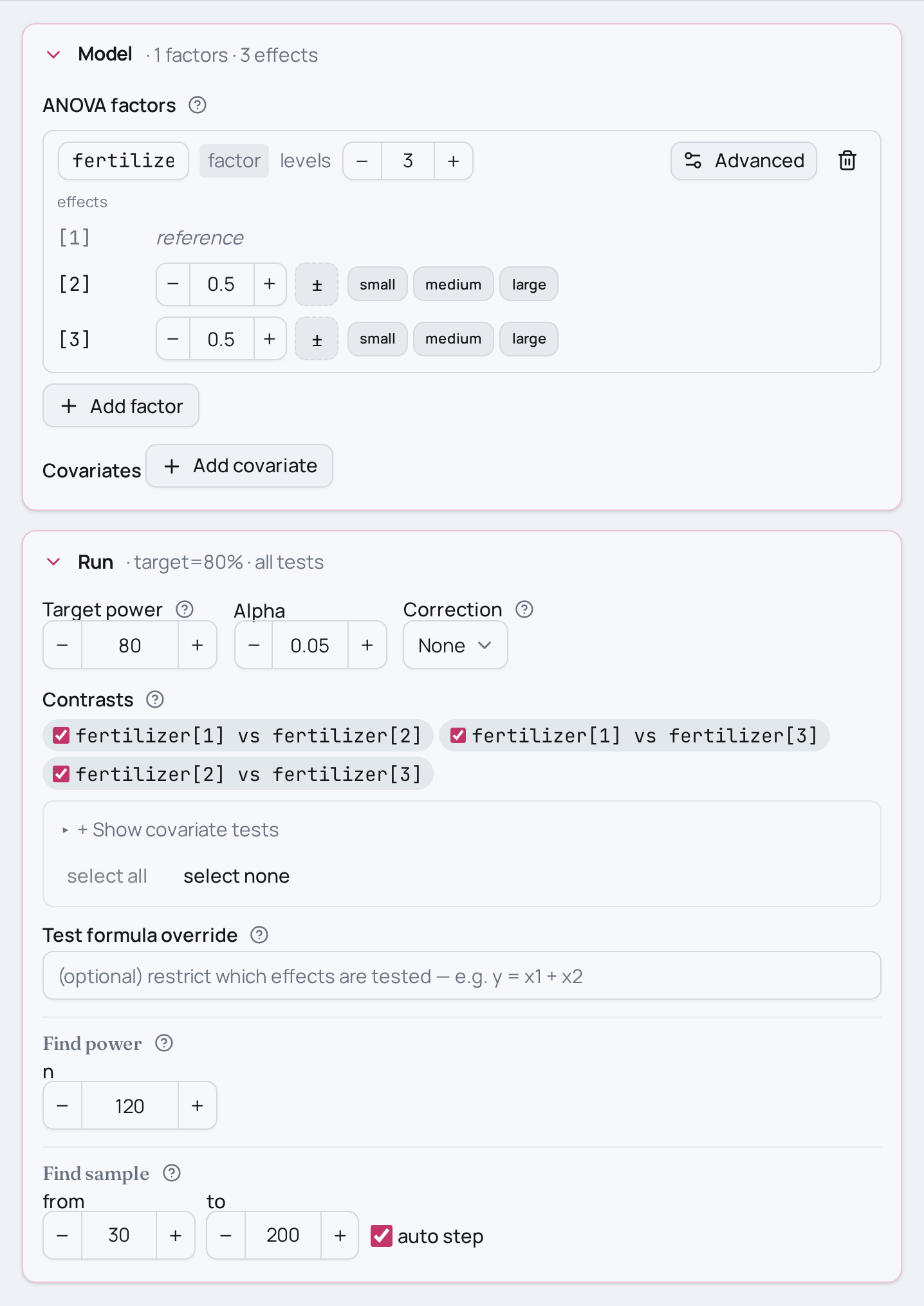
As an MCPower model this is biomass = fertilizer, where fertilizer is a
3-level factor. OLS expands it into dummy contrasts internally, but the omnibus
test pools them into a single F-test of "any group difference" — so power here
is the chance that F-test reaches significance, not the power of any one contrast.
Variations
- More than three groups. Bump the factor to its real arm count —
fertilizer=(factor,4)for a four-regime design. The omnibus F-test absorbs the extra levels automatically; you still request it the same way withtarget_test="all". - Unequal expected effects per arm. A single
fertilizer=0.5puts the same shift on every non-reference level. To say the high-dose arm differs more from control than the low-dose arm, set the level effects apart rather than sharing one number across the factor — the omnibus power reflects the combined spread of group means. - Read the per-group coefficients instead of the omnibus. Swap
target_test="all"fortarget_test="fertilizer"to get power for each dummy contrast against the reference rather than the pooled F-test plus coefficients. - Search for the N instead of fixing it. Swap the
find_powercall forfind_sample_size(target_test="all", from_size=50, to_size=400, by=10)to get the smallest N that takes the omnibus F-test to target power. - Same design, other fields:
pain_reduction = treatment(placebo / drug_a / drug_b) — three-arm clinical trial omnibus F-testlife_satisfaction = region— survey comparing three geographic regions
Not this setup?
- All pairwise post-hoc comparisons, not just the omnibus
- A single planned pairwise contrast instead of the F-test
- The same factor read as per-dummy regression coefficients
If you'd rather have…
- anova/anova-02 — Same one-way design and
biomass = fertilizerformula, but adds all pairwise post-hoc comparisons instead of just the omnibus test. - anova/anova-03 — Same one-way design, but tests a single planned pairwise contrast rather than the omnibus F-test.
- ols/ols-12 — The regression recast: a three-level dummy-coded categorical
predictor (
biomass = condition) — same data structure analysed as OLS. - ols/ols-07 — Drop to two groups: independent t-test as regression
(
biomass = group), the simplest group-comparison case. - anova/anova-04 — Add a second factor: two-way factorial ANOVA with interaction when you have a crossed second grouping variable.
- ols/ols-08 — Add a continuous baseline covariate to the group effect
(ANCOVA,
biomass = fertilizer + baseline).
Copy-paste setup
Python setup
# NOTE: the omnibus F-test cannot be requested on its own — the engine requires
# at least one marginal/contrast/post-hoc target alongside it. target_test="all"
# is the canonical way to get the omnibus: it reports the overall F PLUS every
# per-dummy coefficient. (Bare target_test="overall" is inexpressible and was
# replaced with "all".)
from mcpower import MCPower

# One-way ANOVA: plant biomass measured across three fertilizer regimes.
# Research question: do the fertilizer groups differ overall? -> the omnibus F-test.
model = MCPower("biomass = fertilizer")

# fertilizer is a categorical predictor with 3 levels (control / low / high).
model.set_variable_type("fertilizer=(factor,3)")

# Standardised effects on the factor benchmark scale (0.20 / 0.50 / 0.80):
# each non-reference level shifts biomass by a medium amount vs the control.
# A factor expands into one dummy per non-reference level, so effects are named
# per dummy (fertilizer[2], fertilizer[3]) — the bare factor name is not an effect.
model.set_effects("fertilizer[2]=0.5, fertilizer[3]=0.5")

# Power at N=120 for the omnibus F-test of overall fertilizer differences, reported
# alongside each per-dummy coefficient ("all" = overall F + every β).
model.find_power(sample_size=120, target_test="all")
R setup
# NOTE: the omnibus F-test cannot be requested on its own — the engine requires
# at least one marginal/contrast/post-hoc target alongside it. target_test="all"
# is the canonical way to get the omnibus: it reports the overall F PLUS every
# per-dummy coefficient. (Bare target_test="overall" is inexpressible and was
# replaced with "all".)
suppressMessages(library(mcpower))

# One-way ANOVA: plant biomass measured across three fertilizer regimes.
# Research question: do the fertilizer groups differ overall? -> the omnibus F-test.
model <- MCPower$new("biomass ~ fertilizer")

# fertilizer is a categorical predictor with 3 levels (control / low / high).
model$set_variable_type("fertilizer=(factor,3)")

# Standardised effects on the factor benchmark scale (0.20 / 0.50 / 0.80):
# each non-reference level shifts biomass by a medium amount vs the control.
# A factor expands into one dummy per non-reference level, so effects are named
# per dummy (fertilizer[2], fertilizer[3]) — the bare factor name is not an effect.
model$set_effects("fertilizer[2]=0.5, fertilizer[3]=0.5")

# Power at N=120 for the omnibus F-test of overall fertilizer differences, reported
# alongside each per-dummy coefficient ("all" = overall F + every β).
invisible(model$find_power(sample_size = 120, target_test = "all"))
App setup screenshot