Power for ANOVA pairwise post-hoc comparisons
You ran a three-arm clinical trial — placebo, drug A, and drug B — and measured pain reduction in each participant. A single omnibus "the arms differ" verdict isn't enough: you want to know which treatments differ from which, so you plan all pairwise post-hoc comparisons and need the power for each of them once a multiple-comparison correction is applied.
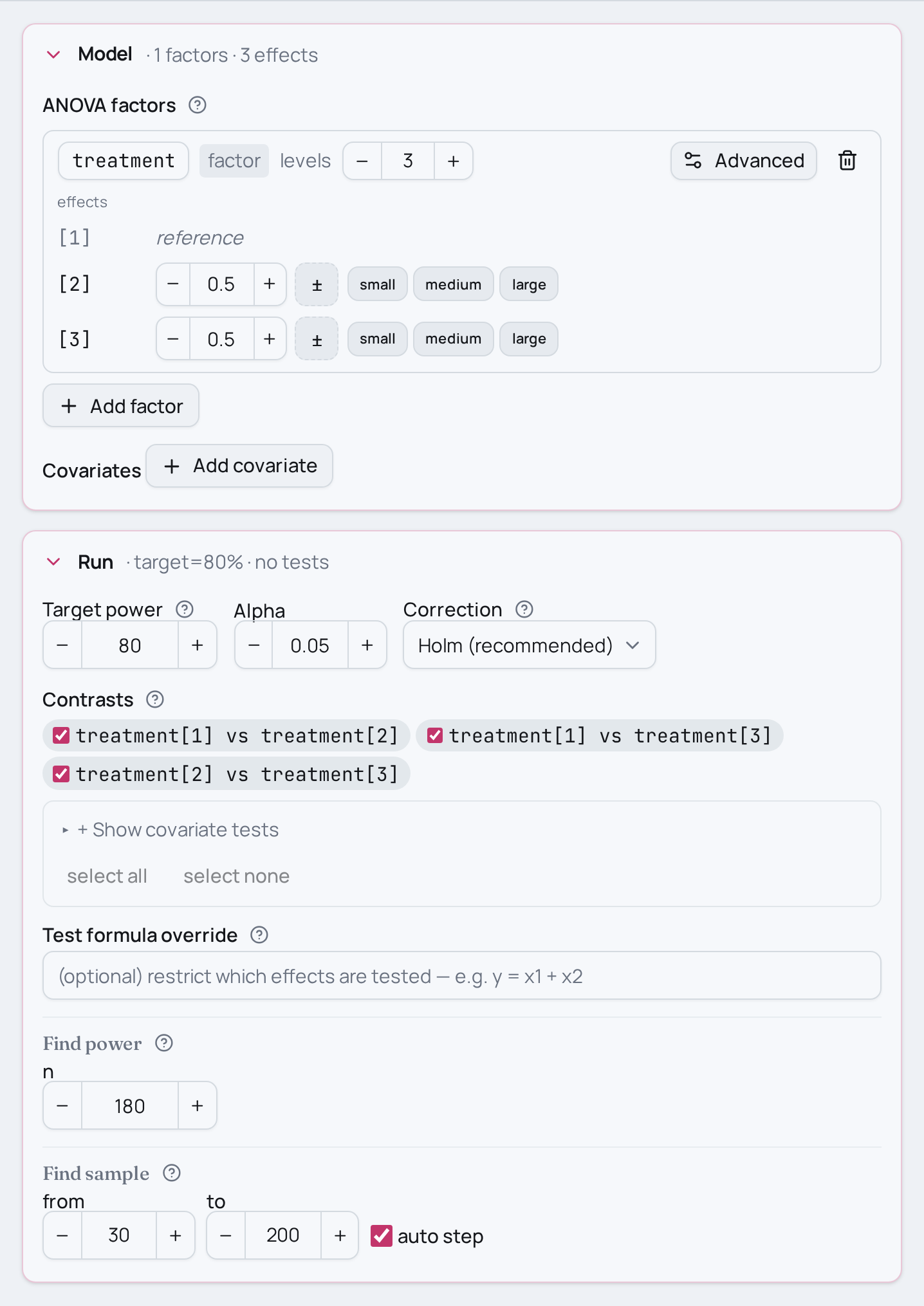
As an MCPower model this is pain_reduction = treatment, where treatment is a
3-level factor. OLS fits the group means and the all-pairwise post-hoc request
turns them into three direct comparisons (placebo vs drug_a, placebo vs drug_b,
drug_a vs drug_b), with a family-wise correction shared across the set.
Variations
- More groups, more pairs. Bump the factor to its real arm count —
treatment=(factor,4)for four arms. The pair count grows fast: four levels give six pairwise comparisons, so the correction has more tests to share and each one needs a larger N for the same power. - A different correction. Swap
correction="holm"for"bonferroni"(more conservative),"bh"(false-discovery-rate, more lenient), or"none"(uncorrected per-comparison power) to see how much the correction costs you. - Unequal group separations. A single
treatment=0.5puts the same spacing on every level. To make drug B further from placebo than drug A, set the level effects apart rather than sharing one number across the factor — the pairwise comparisons then have visibly different power. - Search for the N instead of fixing it. Swap the
find_powercall forfind_sample_size(target_test="all-contrasts", correction="holm", from_size=80, to_size=400, by=20)to get the smallest N that reaches target power on every pairwise comparison. - Same design, other fields:
biomass = fertilizer(control / low / high) — ecology: comparing three fertilizer regimeslife_satisfaction = region— social science: comparing residents of three geographic regions
Not this setup?
- Just the omnibus F — any arm differs, no pairwise breakdown
- One planned pairwise contrast instead of all pairs
- The same factor as dummy contrasts vs a reference level
If you'd rather have…
- anova/anova-01 — Same one-way
pain_reduction ~ treatmentdesign but testing only the omnibus F (any-arm-differs), without the pairwise breakdown. - anova/anova-03 — Same arms, but one planned pairwise contrast instead of all pairwise comparisons — fewer tests, less correction.
- anova/anova-04 — Step up to a two-way factorial (
sector * gender) when a second grouping factor and its interaction are of interest. - ols/ols-12 — The identical three-level categorical predictor framed as dummy-coded regression rather than an ANOVA omnibus/post-hoc.
- ols/ols-07 — Drop to two arms — the pairwise comparison reduces to a single independent t-test as regression.
Copy-paste setup
Python setup
from mcpower import MCPower

# One-way design with all pairwise post-hoc comparisons: pain reduction
# across three treatment arms. Research question goes past "do the arms differ?"
# to "which arms differ from which?" — every treatment-vs-treatment pair, tested directly.
model = MCPower("pain_reduction = treatment")

# treatment is a categorical predictor with 3 levels -> 3 pairwise comparisons
# (placebo-drug_a, placebo-drug_b, drug_a-drug_b).
model.set_variable_type("treatment=(factor,3)")

# Standardised effect on the factor benchmark scale (0.20 / 0.50 / 0.80):
# a medium separation between the treatment means. A 3-level factor expands to two
# reference-coded dummies (treatment[2], treatment[3]) — set each one explicitly.
model.set_effects("treatment[2]=0.5, treatment[3]=0.5")

# Power at N=180 for every pairwise post-hoc comparison, with Holm correction
# to control the family-wise error rate across the three tests.
model.find_power(
    sample_size=180,
    target_test="all-contrasts",
    correction="holm",
)
R setup
suppressMessages(library(mcpower))

# One-way design with all pairwise post-hoc comparisons: pain reduction
# across three treatment arms. Research question goes past "do the arms differ?"
# to "which arms differ from which?" — every treatment-vs-treatment pair, tested directly.
model <- MCPower$new("pain_reduction ~ treatment")

# treatment is a categorical predictor with 3 levels -> 3 pairwise comparisons
# (placebo-drug_a, placebo-drug_b, drug_a-drug_b).
model$set_variable_type("treatment=(factor,3)")

# Standardised effect on the factor benchmark scale (0.20 / 0.50 / 0.80):
# a medium separation between the treatment means. A 3-level factor expands to two
# reference-coded dummies (treatment[2], treatment[3]) — set each one explicitly.
model$set_effects("treatment[2]=0.5, treatment[3]=0.5")

# Power at N=180 for every pairwise post-hoc comparison, with Holm correction
# to control the family-wise error rate across the three tests.
invisible(model$find_power(
  sample_size = 180,
  target_test = "all-contrasts",
  correction = "holm"
))
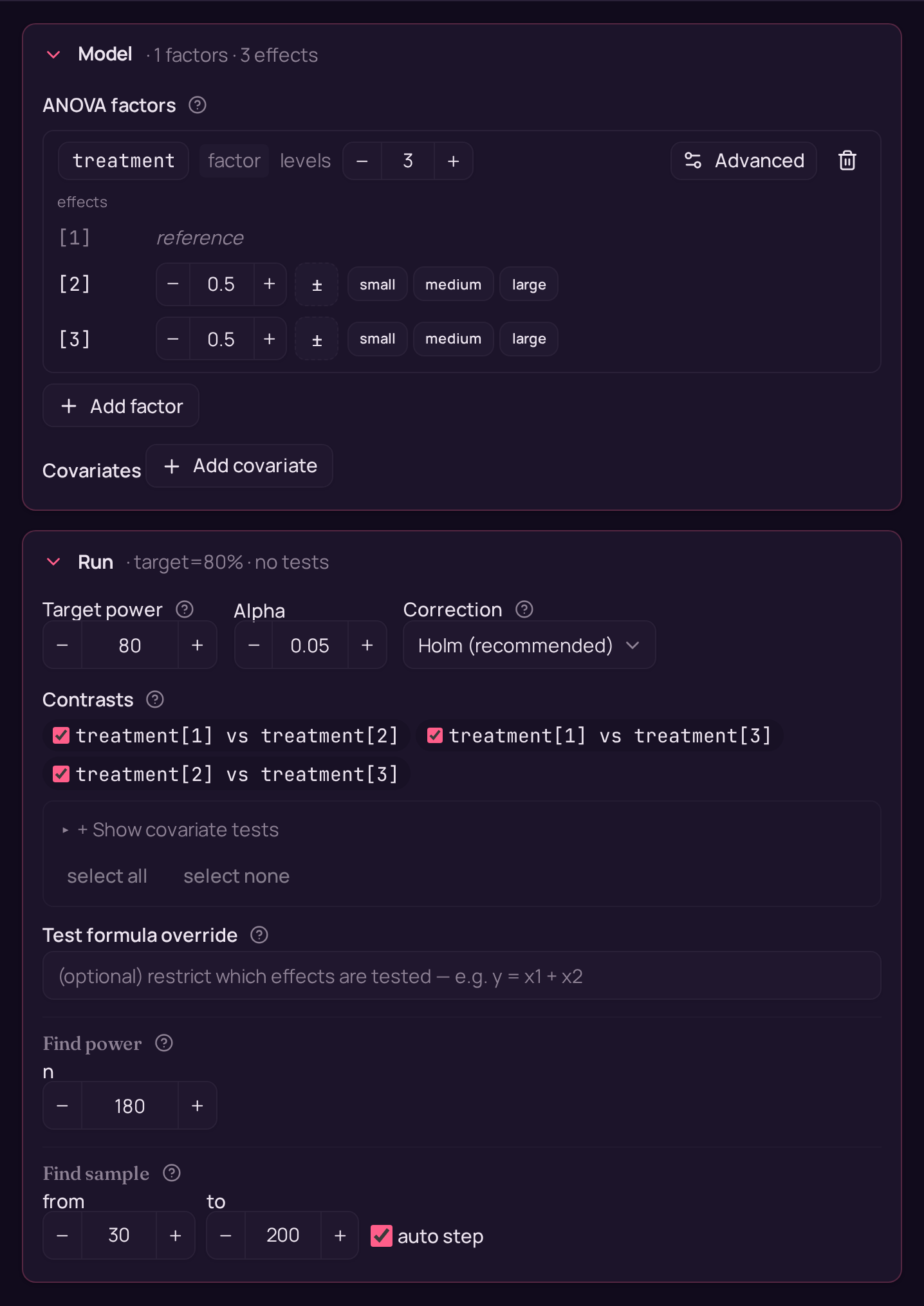
App setup screenshot