Power for a planned ANOVA pairwise contrast
You surveyed residents of three geographic regions and measured life satisfaction. You do not care about every regional comparison: before collecting data you committed to one comparison, say region 2 against region 3. You want the power for that single planned contrast, not an omnibus verdict and not every pairwise test.
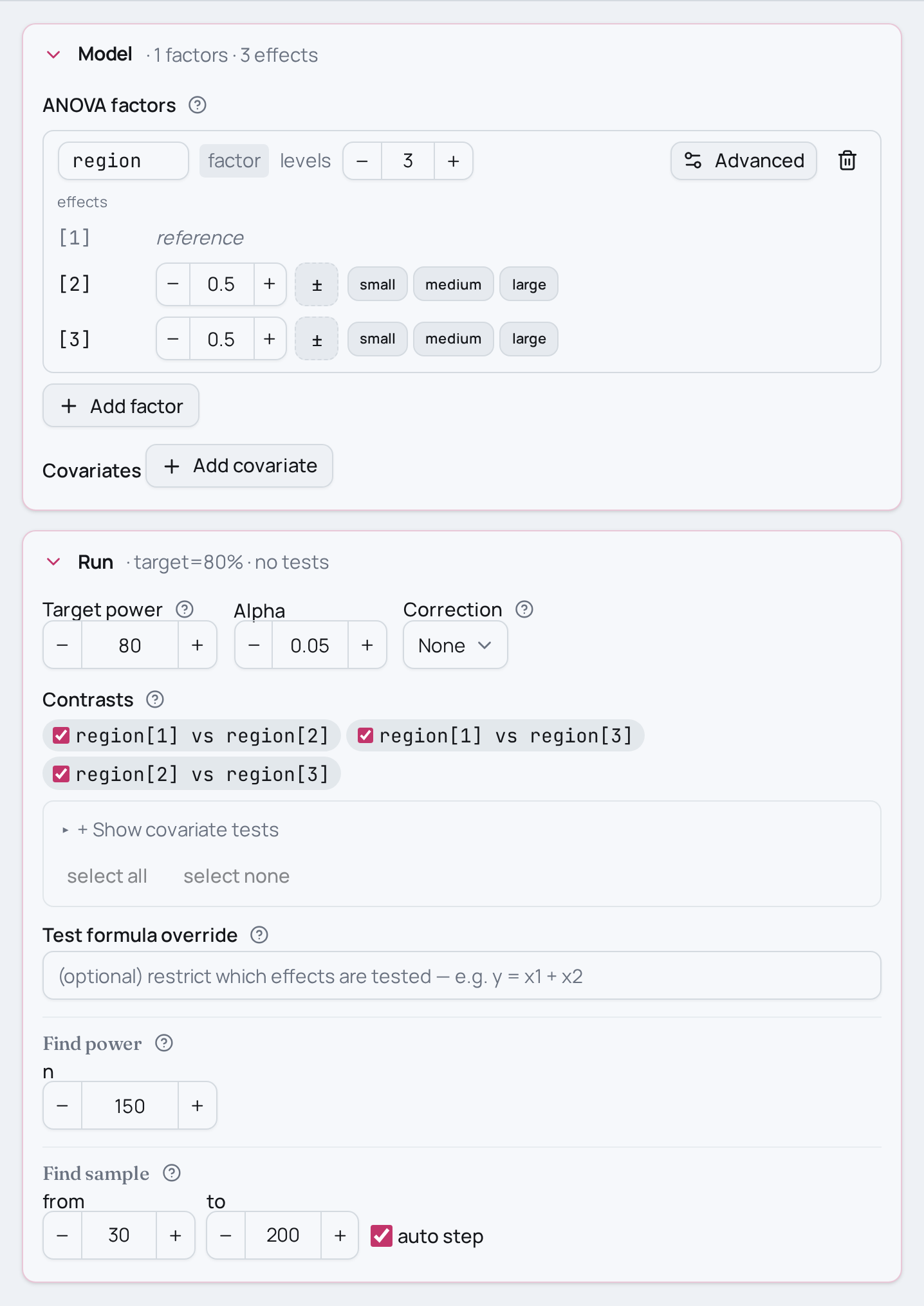
As an MCPower model this is life_satisfaction = region, where region is a
3-level factor. You target one specific pairwise comparison — region[2] vs region[3] — and because it is a single pre-specified contrast it needs no
multiplicity correction.
Variations
- A different pair. Point the contrast at whichever two regions you planned
to compare —
region[1] vs region[2]for region 2 against the reference region, for example. The reference level is just one of the three; any pair is fair game. - One region clearly different. A single
region=0.50puts the same shift on every non-reference level, so the planned contrast lands on the difference of two equal effects. To make the regions differ, set the per-level effects apart rather than sharing one number across the factor. - More than three regions. Bump the factor to its real count —
region=(factor,4)— and the planned-contrast syntax still names exactly the two levels you decided on in advance. - Search for the N instead of fixing it. Swap the
find_powercall forfind_sample_size(target_test="region[2] vs region[3]", from_size=50, to_size=400, by=10)to get the smallest N that reaches target power on that one contrast. - Same design, other fields:
biomass = fertilizer(control / low / high) — ecology: one planned fertilizer comparisonpain_reduction = treatment(placebo / drug_a / drug_b) — clinical: one planned treatment comparison
Not this setup?
- Test every pairwise difference, not just one
- Just the omnibus F-test of overall group differences
- Drop to two groups: a plain independent t-test
If you'd rather have…
- anova/anova-02 — Test every pairwise difference instead of one contrast —
same
life_satisfaction ~ regiondesign, all post-hoc comparisons with multiplicity correction. - anova/anova-01 — Just the omnibus "are the groups different at all" F-test, without any planned or post-hoc pairwise comparison.
- ols/ols-12 — The same 3-level region as a dummy-coded regression — gives each level's coefficient vs the reference rather than ANOVA-style contrasts.
- ols/ols-07 — Drop to two groups — a planned single comparison becomes a plain independent t-test recast as regression.
- anova/anova-04 — Add a second factor for a two-way factorial design with an interaction, if your grouping has crossed structure.
Copy-paste setup
Python setup
from mcpower import MCPower

# Three-arm survey: life satisfaction measured across residents of three regions.
# Research question: you have ONE pre-specified comparison in mind (a planned
# contrast) — e.g. region 2 vs region 3 — decided before seeing the data.
model = MCPower("life_satisfaction = region")

# region is a categorical predictor with 3 levels.
model.set_variable_type("region=(factor,3)")

# Standardised effects on the factor benchmark scale (0.20 / 0.50 / 0.80):
# A factor expands into one dummy per non-reference level, so effects are named
# per dummy (region[2], region[3]) — the bare factor name is not an effect.
model.set_effects("region[2]=0.50, region[3]=0.50")

# Power for the one planned contrast — level 2 vs level 3 of region.
# A single pre-specified comparison needs no multiplicity correction.
model.find_power(sample_size=150, target_test="region[2] vs region[3]")
R setup
suppressMessages(library(mcpower))

# Three-arm survey: life satisfaction measured across residents of three regions.
# Research question: you have ONE pre-specified comparison in mind (a planned
# contrast) — e.g. region 2 vs region 3 — decided before seeing the data.
model <- MCPower$new("life_satisfaction ~ region")

# region is a categorical predictor with 3 levels.
model$set_variable_type("region=(factor,3)")

# Standardised effects on the factor benchmark scale (0.20 / 0.50 / 0.80):
# A factor expands into one dummy per non-reference level, so effects are named
# per dummy (region[2], region[3]) — the bare factor name is not an effect.
model$set_effects("region[2]=0.50, region[3]=0.50")

# Power for the one planned contrast — level 2 vs level 3 of region.
# A single pre-specified comparison needs no multiplicity correction.
invisible(model$find_power(sample_size = 150, target_test = "region[2] vs region[3]"))
App setup screenshot