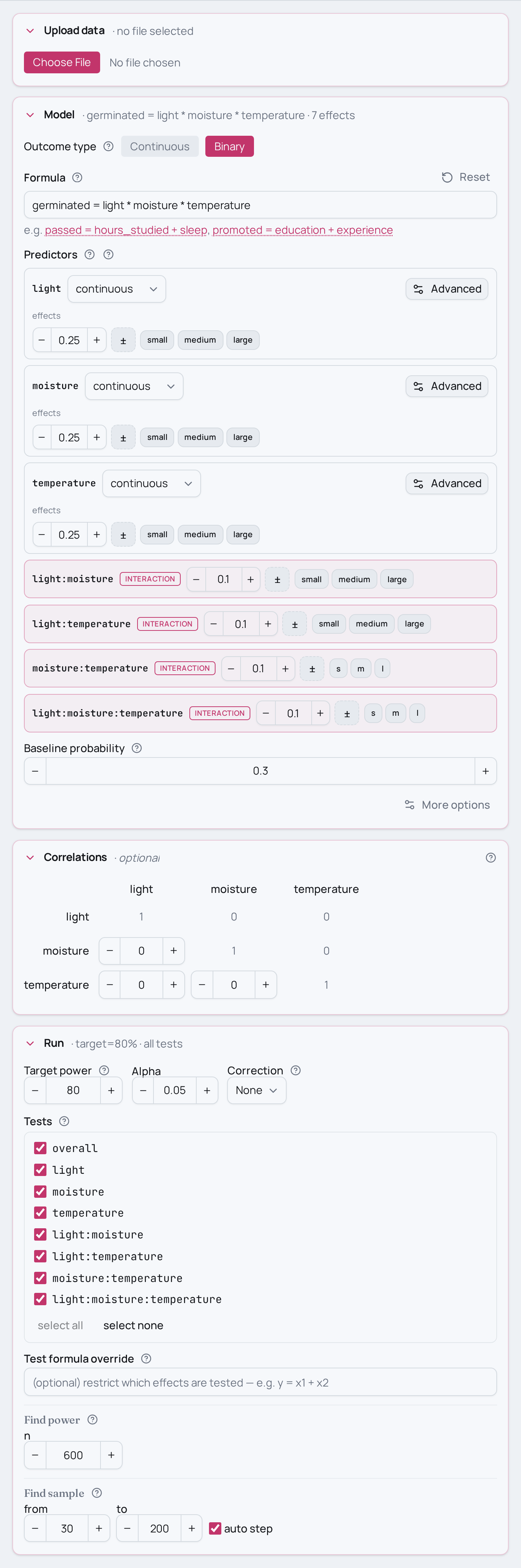
Power for a three-way logistic interaction
Your outcome is binary — germinated or not — and you suspect the way light
moderates the effect of moisture on germination is itself conditional on
temperature. That is a full three-way moderation on the log-odds: an effect of
light that grows with moisture, where that growth is steeper at some
temperatures than others. In MCPower this is the logistic model
germinated ~ light * moisture * temperature, where * expands to all three
main effects, all three two-way interactions, and the single three-way term
light:moisture:temperature — the coefficient you actually care about here.
family="logit" makes germinated a binary (0/1) outcome fitted by a logistic
GLM.
Three-way interactions are notoriously underpowered, and a binary outcome only sharpens the problem: the highest-order term sits on the thinnest slice of the design and carries the least information per observation, so plausible effects need large samples. This page powers the three-way term itself, with main effects at the medium continuous benchmark (0.25) and every interaction at the small benchmark (0.10) on the log-odds scale.
Variations
- Power every term, not just the three-way. Drop
target_test="light:moisture:temperature"and the default reports every coefficient — useful to see how much more sample the three-way needs than the main effects. - Probe the two-way interactions too. Use
target_test="light:moisture, light:temperature, moisture:temperature"to report the three lower-order interactions side by side. - Bigger three-way effect. If theory says the highest-order term is
substantial, raise
light:moisture:temperatureto the medium continuous benchmark (0.25) — the required sample drops sharply. - A factor instead of a continuous predictor. Swap any of
light,moisture,temperaturefor a categorical viaset_variable_type("temperature=(factor,2)"); the interaction then uses the factor benchmark scale (0.20 / 0.50 / 0.80). - Search for the sample, don't guess it. Swap
find_power(sample_size=600, …)forfind_sample_size(target_test="light:moisture:temperature")to get the smallest N that hits 80% power for the three-way term. - Same design, other fields:
relapse ~ biomarker_level * dose * age— does the joint effect of biomarker and dose on relapse depend on patient age? (clinical)voted ~ gender * urban * social_support— does the gender-by-urbanicity interaction on voter turnout vary with social support? (social science)
Not this setup?
- glm/glm-07 — a two-way logistic interaction between two factors (2×2), without the third interacting predictor.
- glm/glm-05 — a neighbouring logistic design with a different predictor and interaction structure.
- ols/ols-05 — the same three-way interaction structure on a continuous outcome (OLS) rather than a binary one.
If you'd rather have…
- A two-way logistic interaction (2×2 factor-by-factor) — drop to two interacting factors if a three-way is more than your design needs.
- A single logistic treatment-by-moderator interaction — binary × continuous, instead of three interacting predictors.
- The same three-way interaction on a continuous outcome — OLS rather than a binary outcome.
- A three-way 2×2×2 factorial as ANOVA omnibus tests — framed as factorial omnibus tests instead of logistic regression coefficients.
- A covariate-adjusted binary outcome, main effects only — no interaction terms at all.
Copy-paste setup
Python setup
from mcpower import MCPower

# Three-way interaction on a yes/no outcome: does the way one environmental
# factor moderates another itself depend on a third, when the response is binary?
# family="logit" makes `germinated` a binary (0/1) outcome fitted by a logistic GLM.
model = MCPower("germinated ~ light * moisture * temperature", family="logit")

# `*` expands to all three main effects, all three two-way interactions, and the
# single three-way term light:moisture:temperature -- the coefficient this page actually powers.
# Standardised effects on the continuous benchmark scale (0.10 / 0.25 / 0.40):
# main effects at medium (0.25), every interaction at small (0.10) on the log-odds.
model.set_effects(
    "light=0.25, moisture=0.25, temperature=0.25, "
    "light:moisture=0.10, light:temperature=0.10, moisture:temperature=0.10, "
    "light:moisture:temperature=0.10"
)
model.set_simulations(1600)
model.set_seed(2137)

# Logistic GLMs need a baseline event rate: it pins the intercept so the
# log-odds effects above land on a concrete probability scale. Required for
# family="logit" -- find_power errors without it.
model.set_baseline_probability(0.3)

# Power at N=600 for the three-way term itself (the thinnest slice of the design).
model.find_power(sample_size=600, target_test="light:moisture:temperature")
R setup
suppressMessages(library(mcpower))

# Three-way interaction on a yes/no outcome: does the way one environmental
# factor moderates another itself depend on a third, when the response is binary?
# family="logit" makes `germinated` a binary (0/1) outcome fitted by a logistic GLM.
model <- MCPower$new("germinated ~ light * moisture * temperature", family = "logit")

# `*` expands to all three main effects, all three two-way interactions, and the
# single three-way term light:moisture:temperature -- the coefficient this page actually powers.
# Standardised effects on the continuous benchmark scale (0.10 / 0.25 / 0.40):
# main effects at medium (0.25), every interaction at small (0.10) on the log-odds.
model$set_effects(paste0(
  "light=0.25, moisture=0.25, temperature=0.25, ",
  "light:moisture=0.10, light:temperature=0.10, moisture:temperature=0.10, ",
  "light:moisture:temperature=0.10"
))
model$set_simulations(1600)
model$set_seed(2137)

# Logistic GLMs need a baseline event rate: it pins the intercept so the
# log-odds effects above land on a concrete probability scale. Required for
# family="logit" -- find_power errors without it.
model$set_baseline_probability(0.3)

# Power at N=600 for the three-way term itself (the thinnest slice of the design).
invisible(model$find_power(sample_size = 600, target_test = "light:moisture:temperature"))
App setup screenshot