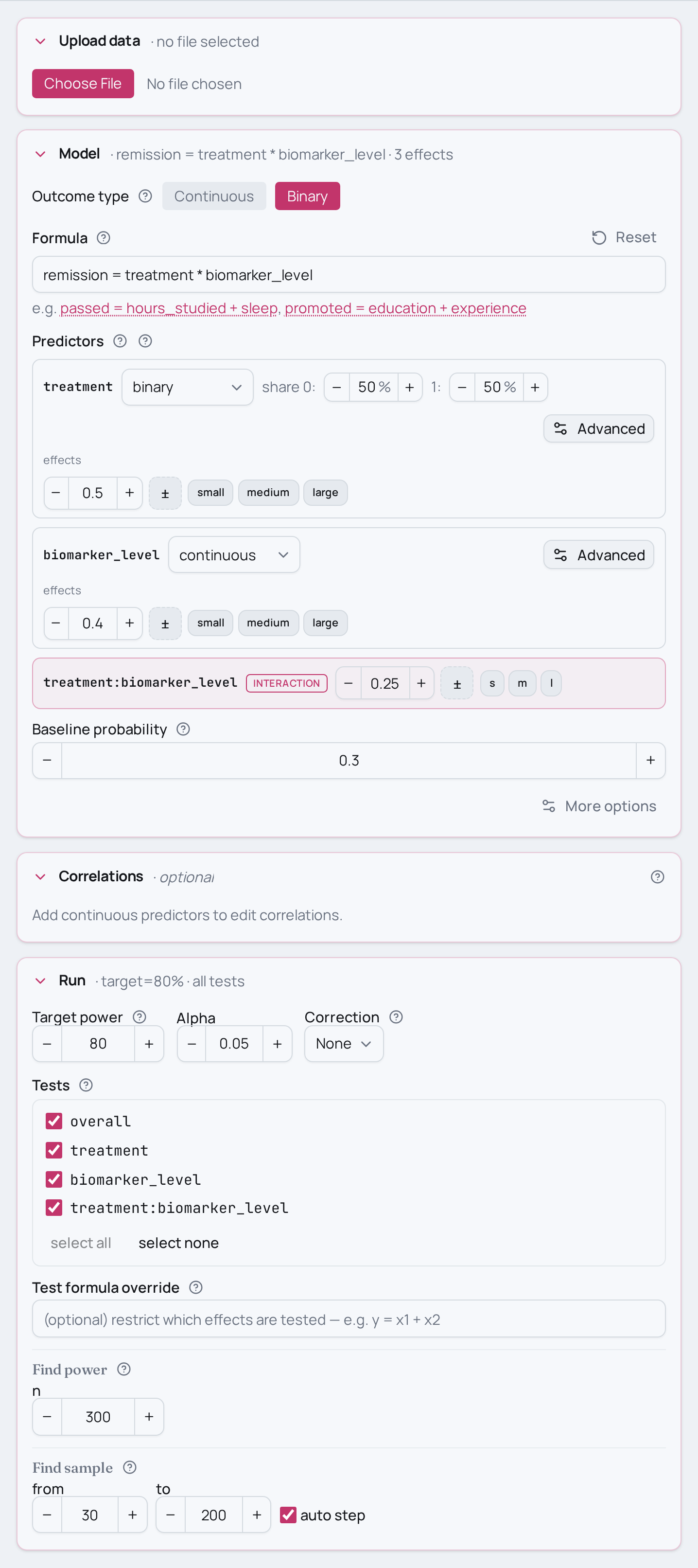
Power for a logistic treatment-by-covariate interaction
You ran a two-arm trial with a yes/no outcome — did the patient reach remission?
— and measured each patient's biomarker level at baseline. Before trusting a
single average treatment effect on the odds of remission, you want to know
whether the treatment works differently depending on the patient's biomarker
profile: does the log-odds slope on biomarker_level differ between the
treatment and control arms? That is a treatment-by-covariate interaction on a
binary outcome — the logistic analogue of an ANCOVA homogeneity-of-slopes test.
As an MCPower formula this is remission ~ treatment * biomarker_level with
family="logit", where * expands to
treatment + biomarker_level + treatment:biomarker_level. treatment is a
two-level arm and biomarker_level is a continuous covariate; the test of
interest is the interaction term treatment:biomarker_level.
Variations
- Search for the N you need instead of scoring one design: swap
find_power(sample_size=300, …)forfind_sample_size(target_test="treatment:biomarker_level", from_size=150, to_size=800, by=25). Interactions on a binary outcome need markedly more N than main effects, so widen the upper bound rather than guess. - Test the adjusted main effect too by setting
target_test="treatment"(ortarget_test="all"for every term plus the omnibus), if you also care about the average treatment effect on the odds of remission, not only the slope difference. - Stronger or weaker moderation: move
treatment:biomarker_levelbetween 0.10 (a subtle difference in how the arms respond to biomarker level) and 0.40 (the two arms respond very differently) to see how fast power for the moderation test collapses as the effect shrinks. - A graded treatment intensity instead of two arms: drop
set_variable_type("treatment=binary")and keeptreatmentcontinuous — that turns the design into continuous-by-continuous moderation on the log-odds. - Same design, other fields:
germinated ~ rainfall * soil_nitrogen— does the effect of rainfall on germination depend on soil nitrogen? (ecology)voted ~ urban * social_support— does the effect of urban residence on voting depend on social support levels? (social science)
Not this setup?
- Logistic continuous-by-continuous moderation
- Logistic factor-by-factor interaction (2x2)
- Binary-by-continuous moderation
If you'd rather have…
- ANCOVA with treatment-by-covariate interaction (homogeneity of slopes) — Same treatment-by-covariate interaction structure but on a continuous outcome (ANCOVA homogeneity-of-slopes) instead of a binary one.
- Multiple logistic regression: covariate-adjusted binary outcome — Logistic with the treatment effect adjusted for covariates but no interaction term, if the moderation is not of interest.
- Logistic three-way interaction on a binary outcome — Extends the logistic interaction to a three-way moderation if a second moderator is in play.
Copy-paste setup
Python setup
from mcpower import MCPower

# Logistic regression with a treatment-by-covariate interaction: does the
# treatment's effect on the odds of remission depend on how elevated the patient's
# biomarker was at baseline? '*' expands treatment * biomarker_level to
# treatment + biomarker_level + treatment:biomarker_level, so the
# moderation term is fitted explicitly. family="logit" makes remission a binary
# (0/1) outcome fitted by a logistic GLM.
model = MCPower("remission = treatment * biomarker_level", family="logit")

# treatment is a two-level arm (0=control, 1=treatment); biomarker_level is a
# continuous covariate.
model.set_variable_type("treatment=binary")

# Effect sizes on the benchmark scale.
#   treatment=0.50                     -> medium arm shift (binary benchmark).
#   biomarker_level=0.40               -> strong covariate-outcome association
#                                         on the log-odds (continuous benchmark).
#   treatment:biomarker_level=0.25     -> moderate moderation (the interaction).
model.set_effects("treatment=0.50, biomarker_level=0.40, treatment:biomarker_level=0.25")

# A logistic GLM needs a baseline event rate to anchor the intercept: 30% of
# control patients reach remission when every predictor is at its reference
# value. family="logit" requires this before find_power.
model.set_baseline_probability(0.30)

model.set_seed(2137)

# Power for the moderation test (the interaction) at N=300.
model.find_power(sample_size=300, target_test="treatment:biomarker_level")
R setup
suppressMessages(library(mcpower))

# Logistic regression with a treatment-by-covariate interaction: does the
# treatment's effect on the odds of remission depend on how elevated the patient's
# biomarker was at baseline? '*' expands treatment * biomarker_level to
# treatment + biomarker_level + treatment:biomarker_level, so the
# moderation term is fitted explicitly. family = "logit" makes remission a
# binary (0/1) outcome fitted by a logistic GLM.
model <- MCPower$new("remission ~ treatment * biomarker_level", family = "logit")

# treatment is a two-level arm (0=control, 1=treatment); biomarker_level is a
# continuous covariate.
model$set_variable_type("treatment=binary")

# Effect sizes on the benchmark scale.
#   treatment=0.50                     -> medium arm shift (binary benchmark).
#   biomarker_level=0.40               -> strong covariate-outcome association
#                                         on the log-odds (continuous benchmark).
#   treatment:biomarker_level=0.25     -> moderate moderation (the interaction).
model$set_effects("treatment=0.50, biomarker_level=0.40, treatment:biomarker_level=0.25")

# A logistic GLM needs a baseline event rate to anchor the intercept: 30% of
# control patients reach remission when every predictor is at its reference
# value. family = "logit" requires this before find_power.
model$set_baseline_probability(0.30)

model$set_seed(2137)

# Power for the moderation test (the interaction) at N=300.
invisible(model$find_power(sample_size = 300, target_test = "treatment:biomarker_level"))
App setup screenshot