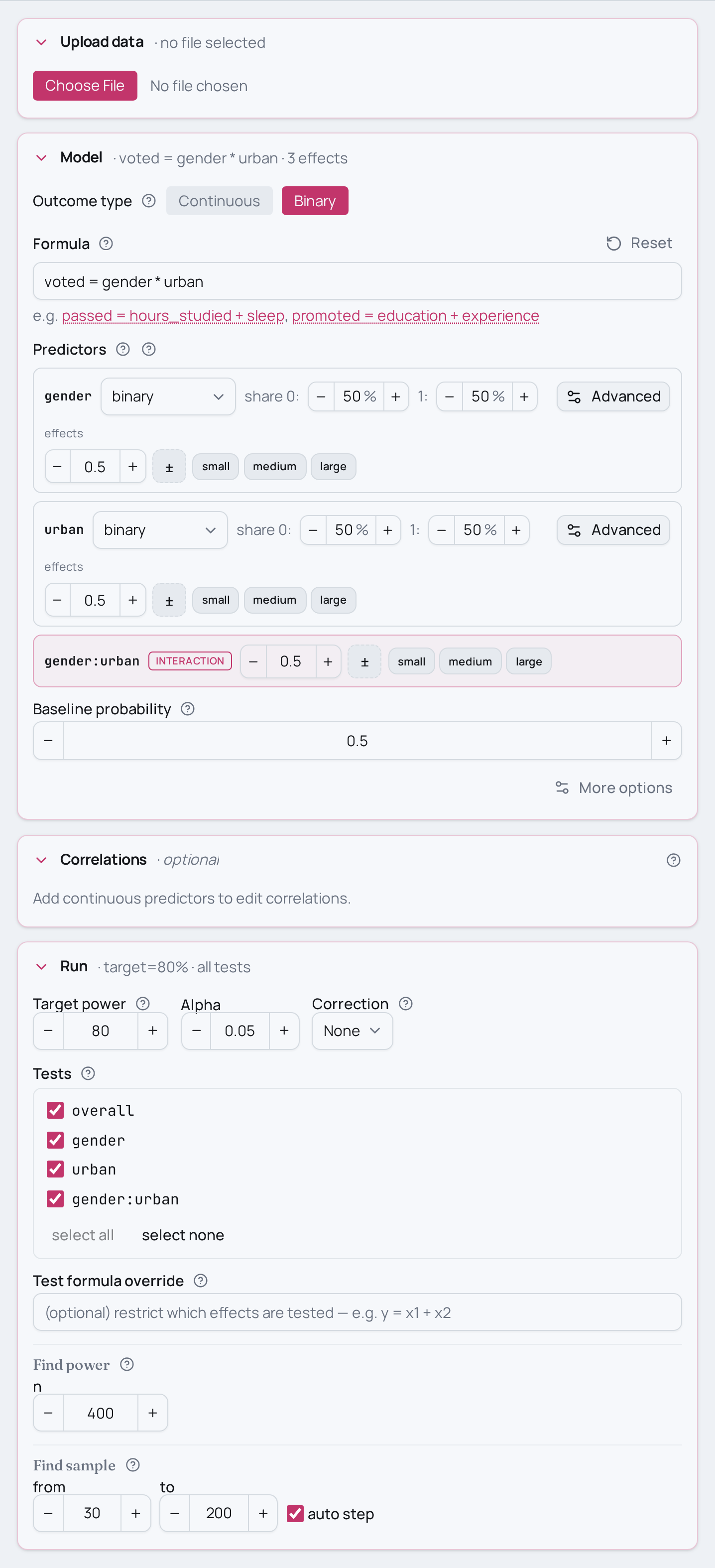
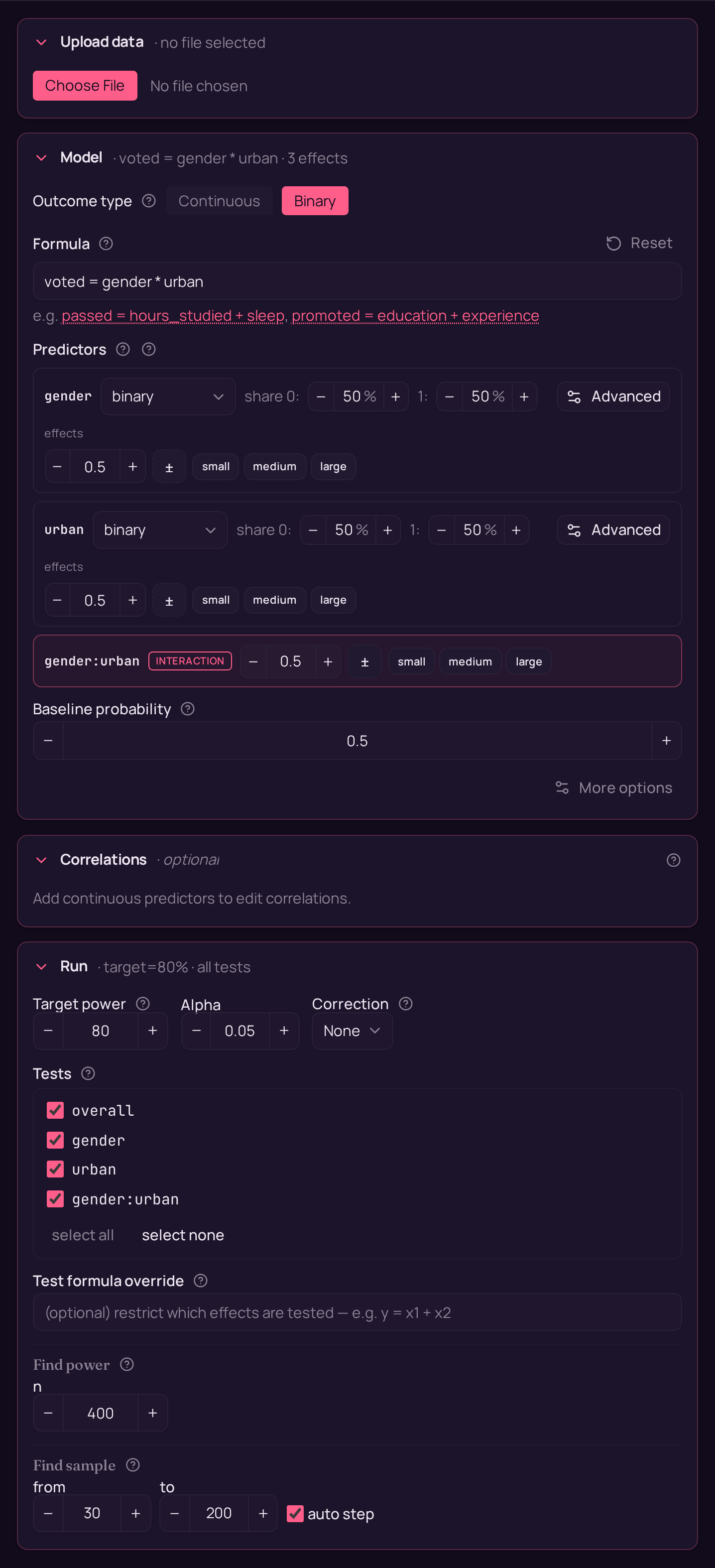
Power for a 2x2 logistic factorial interaction
You ran a survey with a yes/no outcome — did the respondent vote? — and
crossed two two-level factors: gender (women vs men) fully crossed with urban
residence (urban vs rural). The question that motivated the design is not either
main effect but whether they interact: does the gender gap in voter turnout
differ between urban and rural respondents? That is the classic 2x2 factorial
interaction, the difference in cell differences — here on the log-odds scale,
because the outcome is binary.
As an MCPower formula this is voted ~ gender * urban with family="logit",
where * expands to gender + urban + gender:urban. Both gender and urban
are two-level factors; the test of interest is the interaction term
gender:urban, fitted by a logistic GLM.
Variations
- Search for the N you need instead of scoring one design: swap
find_power(sample_size=400, …)forfind_sample_size(target_test="gender:urban", from_size=200, to_size=1200, by=50). A logistic interaction needs markedly more N than either main effect — and binary outcomes carry less information than continuous ones — so set the upper bound generously. - Test the main effects too by setting
target_test="gender"(ortarget_test="all"for every term plus the omnibus), if you also care about the average effects, not only the interaction. - Stronger or weaker moderation: move
gender:urbanacross the factor benchmarks — 0.20 (subtle), 0.50 (medium), 0.80 (the two residence groups show very different gender gaps) — to watch how fast power for the interaction collapses as the effect shrinks. - A wider design: give one factor three or more levels with
set_variable_type("urban=(factor,3)")— the interaction then spans several contrasts and demands still more N. - Same design, other fields:
infection ~ treatment * dose_level— does the effect of treatment on infection depend on dose level? (clinical)germinated ~ light * moisture— does the effect of light on germination depend on moisture availability? (ecology)
Not this setup?
- Logistic three-way interaction on a binary outcome
- Logistic continuous-by-continuous moderation
- Logistic treatment-by-moderator interaction (binary x continuous)
- Logistic regression with a multi-level categorical predictor
If you'd rather have…
- Logistic three-way interaction on a binary outcome — Add a third factor: logistic three-way interaction on a binary outcome (abc).
- Logistic continuous-by-continuous moderation — Same logistic interaction but with two continuous moderators instead of two factors.
- Logistic treatment-by-moderator interaction (binary x continuous) — Mixed interaction: a binary treatment crossed with a continuous moderator on a binary outcome.
- Logistic regression with a multi-level categorical predictor — Drop the interaction: a single multi-level categorical predictor on a binary outcome.
- Two interacting categorical predictors (factorial as regression) — Same two interacting categorical predictors but on a continuous outcome (factorial as OLS regression).
- Two-way factorial ANOVA with interaction (2x2 / 2x3 / 3x3 / 2x4) — The 2x2 factorial framed as a two-way ANOVA with interaction on a continuous outcome.
Copy-paste setup
Python setup
from mcpower import MCPower

# 2x2 factorial on a yes/no outcome: did the respondent vote? The question is
# whether the effect of `gender` on voting depends on `urban` residence.
# '*' expands gender * urban to gender + urban + gender:urban, so the
# interaction (the difference in cell differences, on the log-odds scale) is
# fitted explicitly. family="logit" makes voted binary (0/1) and fits a GLM.
model = MCPower("voted = gender * urban", family="logit")

# Both predictors are two-level factors: gender (e.g. women vs men) and
# urban (e.g. urban vs rural).
model.set_variable_type("gender=binary, urban=binary")

# Effect sizes on the factor benchmark scale (0.20 / 0.50 / 0.80), each a shift
# in the log-odds of voting:
#   gender=0.50        -> medium main effect of gender.
#   urban=0.50         -> medium main effect of urban residence.
#   gender:urban=0.50  -> medium interaction (the moderation effect).
model.set_effects("gender=0.50, urban=0.50, gender:urban=0.50")

# Baseline voting rate in the reference cell (logit family needs a baseline probability).
model.set_baseline_probability(0.50)

model.set_seed(2137)

# Power for the interaction (the 2x2 cell-difference test) at N=400.
model.find_power(sample_size=400, target_test="gender:urban")
R setup
suppressMessages(library(mcpower))

# 2x2 factorial on a yes/no outcome: did the respondent vote? The question is
# whether the effect of `gender` on voting depends on `urban` residence.
# '*' expands gender * urban to gender + urban + gender:urban, so the
# interaction (the difference in cell differences, on the log-odds scale) is
# fitted explicitly. family="logit" makes voted binary (0/1) and fits a GLM.
model <- MCPower$new("voted ~ gender * urban", family = "logit")

# Both predictors are two-level factors: gender (e.g. women vs men) and
# urban (e.g. urban vs rural).
model$set_variable_type("gender=binary, urban=binary")

# Effect sizes on the factor benchmark scale (0.20 / 0.50 / 0.80), each a shift
# in the log-odds of voting:
#   gender=0.50        -> medium main effect of gender.
#   urban=0.50         -> medium main effect of urban residence.
#   gender:urban=0.50  -> medium interaction (the moderation effect).
model$set_effects("gender=0.50, urban=0.50, gender:urban=0.50")

# Baseline voting rate in the reference cell (logit family needs a baseline probability).
model$set_baseline_probability(0.50)

model$set_seed(2137)

# Power for the interaction (the 2x2 cell-difference test) at N=400.
invisible(model$find_power(sample_size = 400, target_test = "gender:urban"))
App setup screenshot