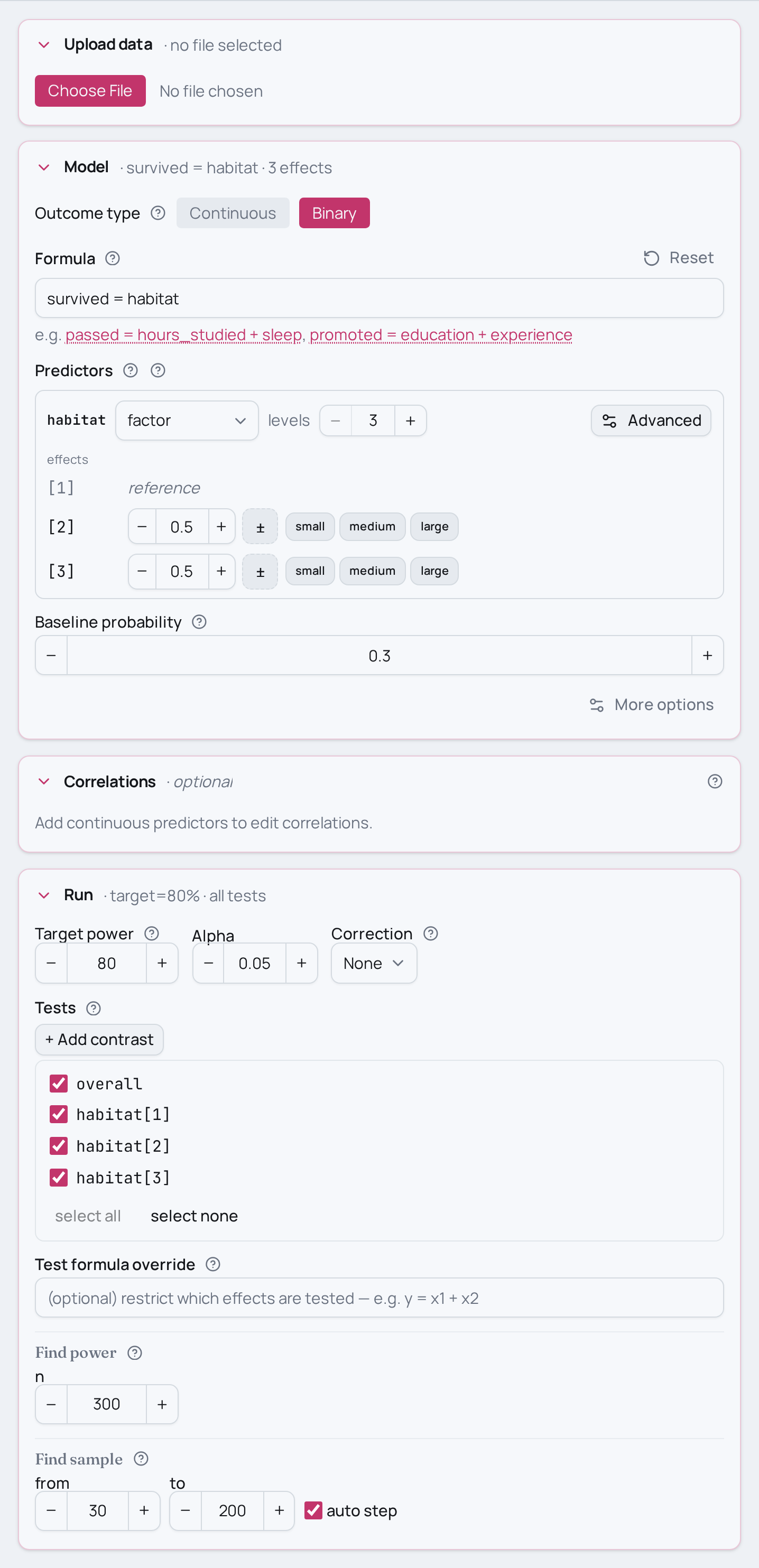
Power for logistic regression with a categorical predictor
You sampled seedlings across three habitat types — a reference habitat and two alternatives — and recorded a binary outcome for each seedling: did it survive (yes/no)? You want the power to detect that the habitat types differ in survival probability, read off the individual habitat coefficients rather than a single omnibus verdict.
As an MCPower model this is survived ~ habitat with family="logit",
where habitat is a 3-level factor and survived is the binary outcome.
The logistic GLM expands the factor into two dummy contrasts, each comparing a
non-reference habitat against the reference habitat on the log-odds scale, and
reports power for each contrast separately.
Variations
- More than three habitats. Bump the factor to its real level count —
habitat=(factor,4)for a four-habitat study. Each extra level adds one more dummy contrast (and one more row of power) against the same reference habitat. - Unequal expected effects per habitat. A single
habitat=0.5puts the same log-odds shift on every non-reference habitat. To say the second habitat differs more strongly, set the level effects apart rather than sharing one number across the factor. - A covariate to soak up noise. Add a continuous control, e.g.
survived ~ habitat + soil_nitrogen, withsoil_nitrogenon the continuous benchmark scale (soil_nitrogen=0.25) — adjusting the binary outcome for a prognostic covariate. - Search for the N instead of fixing it. Swap the
find_powercall forfind_sample_size(target_test="habitat", from_size=100, to_size=600, by=20)to get the smallest N that reaches target power on both contrasts. - Same design, other fields:
relapse ~ treatment_arm— does treatment arm predict relapse in a three-arm clinical trial? (clinical)employed ~ sector— do employment rates differ across three industry sectors? (social science)
Not this setup?
- A binary predictor instead of a 3-level factor
- A single continuous predictor on the binary outcome
- The same three-arm design but on a continuous outcome
If you'd rather have…
- ols/ols-12 — Same multi-level (3-level) categorical predictor, but on a continuous outcome instead of a binary one.
- glm/glm-09 — Logistic outcome where a categorical predictor enters as a control alongside a continuous predictor.
- anova/anova-01 — Omnibus test of differences across 3+ groups — the linear-model analogue of comparing habitat types.
- glm/glm-04 — Multiple logistic regression adjusting the binary outcome for additional covariates.
Copy-paste setup
Python setup
from mcpower import MCPower

# Three-habitat ecology study with a yes/no outcome: did the seedling survive?
# Research question: do the habitat types differ in seedling survival probability,
# tested as the two dummy contrasts against the reference habitat.
# family="logit" makes survived a binary (0/1) outcome fitted by a logistic GLM.
model = MCPower("survived = habitat", family="logit")

# habitat is a categorical predictor with 3 levels -> 2 dummy contrasts.
# A 3-level factor expands into per-level dummies habitat[2] and
# habitat[3] (level 1 is the reference); effects and tests address those
# dummy names directly, not the bare factor name.
model.set_variable_type("habitat=(factor,3)")

# Standardised effects on the factor benchmark scale (0.20 / 0.50 / 0.80):
# each non-reference habitat shifts the log-odds of survival by a medium amount
# relative to the reference habitat.
model.set_effects("habitat[2]=0.5, habitat[3]=0.5")

# family="logit" requires a baseline event rate: the survival probability in the
# reference habitat when all predictors are at their reference. It sets the model
# intercept (log-odds) for every Monte Carlo iteration; without it find_power
# raises. 0.30 = a 30% reference-habitat survival rate.
model.set_baseline_probability(0.30)

# Power at N=300 for both dummy contrasts (each habitat vs the reference habitat).
model.find_power(sample_size=300, target_test="habitat[2], habitat[3]")
R setup
suppressMessages(library(mcpower))

# Three-habitat ecology study with a yes/no outcome: did the seedling survive?
# Research question: do the habitat types differ in seedling survival probability,
# tested as the two dummy contrasts against the reference habitat.
# family="logit" makes survived a binary (0/1) outcome fitted by a logistic GLM.
model <- MCPower$new("survived ~ habitat", family = "logit")

# habitat is a categorical predictor with 3 levels -> 2 dummy contrasts.
# A 3-level factor expands into per-level dummies habitat[2] and
# habitat[3] (level 1 is the reference); effects and tests address those
# dummy names directly, not the bare factor name.
model$set_variable_type("habitat=(factor,3)")

# Standardised effects on the factor benchmark scale (0.20 / 0.50 / 0.80):
# each non-reference habitat shifts the log-odds of survival by a medium amount
# relative to the reference habitat.
model$set_effects("habitat[2]=0.5, habitat[3]=0.5")

# family="logit" requires a baseline event rate: the survival probability in the
# reference habitat when all predictors are at their reference. It sets the model
# intercept (log-odds) for every Monte Carlo iteration; without it find_power
# raises. 0.30 = a 30% reference-habitat survival rate.
model$set_baseline_probability(0.30)

# Power at N=300 for both dummy contrasts (each habitat vs the reference habitat).
invisible(model$find_power(sample_size = 300, target_test = "habitat[2], habitat[3]"))
App setup screenshot