Power analysis for simple logistic regression
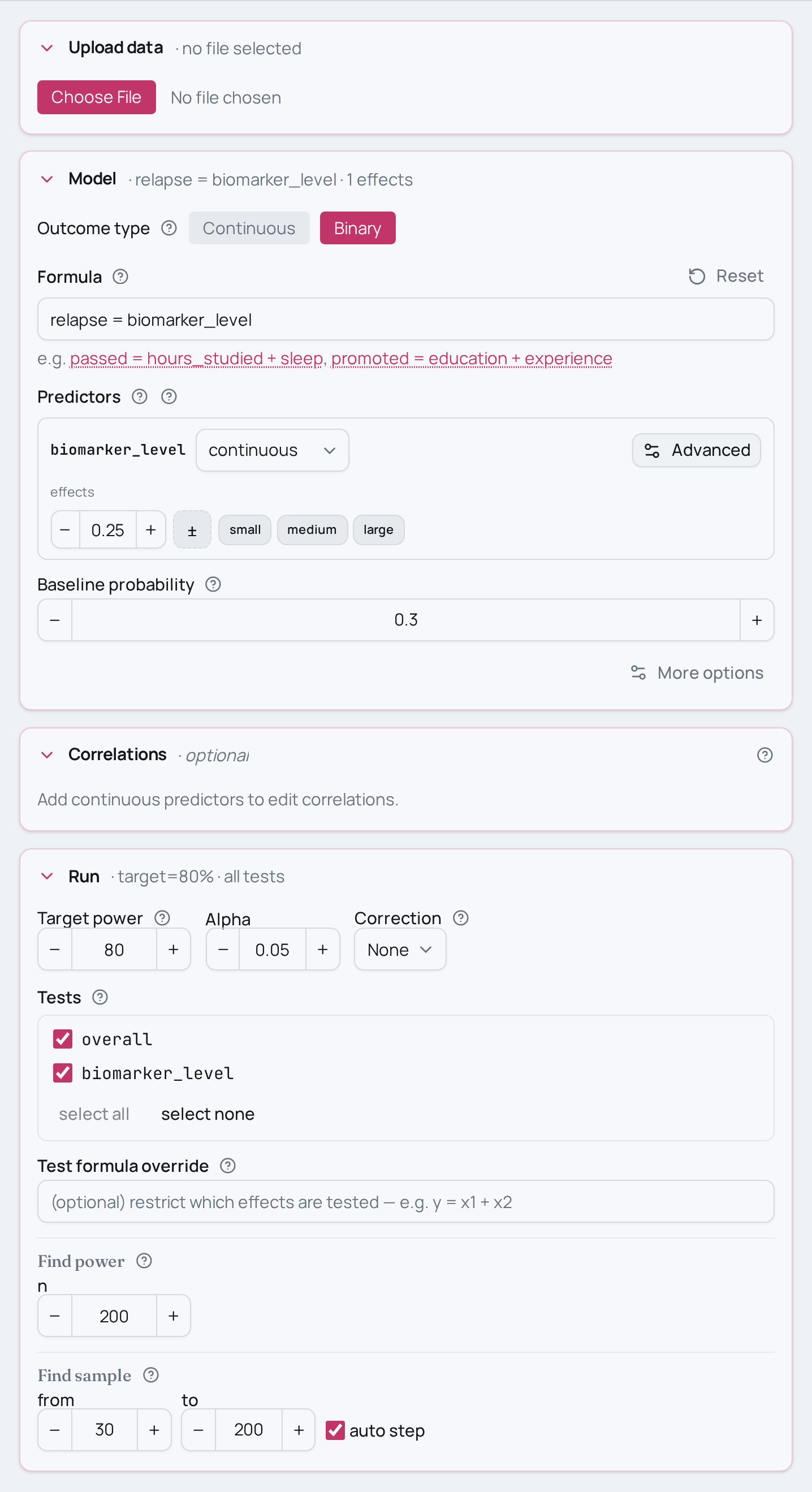
Does a patient's biomarker_level shift the odds of relapse (yes/no)? That is
the starting point for a binary outcome: one continuous predictor, no covariates,
no interactions. As an MCPower formula this is relapse ~ biomarker_level with
family="logit": a binary outcome fitted by a logistic GLM, one continuous
predictor, nothing else held constant.
Variations
- Dial the expected association up or down by changing the effect:
biomarker_level=0.10for a small relationship,biomarker_level=0.40for a large one (the medium benchmark for a continuous predictor is0.25). - Searching for the sample size that reaches 80% power instead of scoring a
fixed N? Swap
find_power(sample_size=200, ...)forfind_sample_size(target_test="biomarker_level", from_size=50, to_size=500, by=10). - Same design, other fields:
germination_rate ~ soil_nitrogen— does soil nitrogen predict whether a seed germinates? (ecology)voted ~ social_support— does social support shift the odds of turning out to vote? (social science)
Not this setup?
- Two-group / binary predictor (chi-square recast)
- Multi-level categorical predictor (outcome ~ group)
- Adjusted binary-outcome model with covariates
If you'd rather have…
- Two-group comparison of proportions — the predictor is a two-group/binary variable instead of continuous (chi-square recast).
- Categorical predictor — the predictor is a multi-level categorical instead of a single continuous one.
- Adjusted association with covariates — add covariates for an adjusted binary-outcome model (age, gender).
- Moderation between two predictors — add a second continuous predictor with their interaction.
- Continuous predictor with a categorical control — keep the continuous predictor but add a categorical control.
- Same design on a continuous outcome — the same one-continuous-predictor design but on a continuous outcome (linear instead of logistic).
Copy-paste setup
Python setup
from mcpower import MCPower

# Simple logistic regression: a binary (yes/no) outcome on one continuous
# predictor. family="logit" makes the outcome binary and fits a GLM.
model = MCPower("relapse = biomarker_level", family="logit")

# family="logit" requires a baseline event rate: the probability of relapse=1
# at the predictor's reference level. This pins the intercept (log-odds).
model.set_baseline_probability(0.3)

# Expected effect on the standardised benchmark scale (continuous predictor):
#   biomarker_level=0.25 -> a medium association with the log-odds of relapse.
model.set_effects("biomarker_level=0.25")

# Power at N=200 with the GLM defaults (1600 sims, alpha=0.05, seed=2137).
model.find_power(sample_size=200, target_test="biomarker_level")
R setup
suppressMessages(library(mcpower))

# Simple logistic regression: a binary (yes/no) outcome on one continuous
# predictor. family = "logit" makes the outcome binary and fits a GLM.
model <- MCPower$new("relapse ~ biomarker_level", family = "logit")

# family = "logit" requires a baseline event rate: the probability of relapse=1
# at the predictor's reference level. This pins the intercept (log-odds).
model$set_baseline_probability(0.3)

# Expected effect on the standardised benchmark scale (continuous predictor):
#   biomarker_level=0.25 -> a medium association with the log-odds of relapse.
model$set_effects("biomarker_level=0.25")

# Power at N=200 with the GLM defaults (1600 sims, alpha=0.05, seed=2137).
invisible(model$find_power(sample_size = 200, target_test = "biomarker_level"))
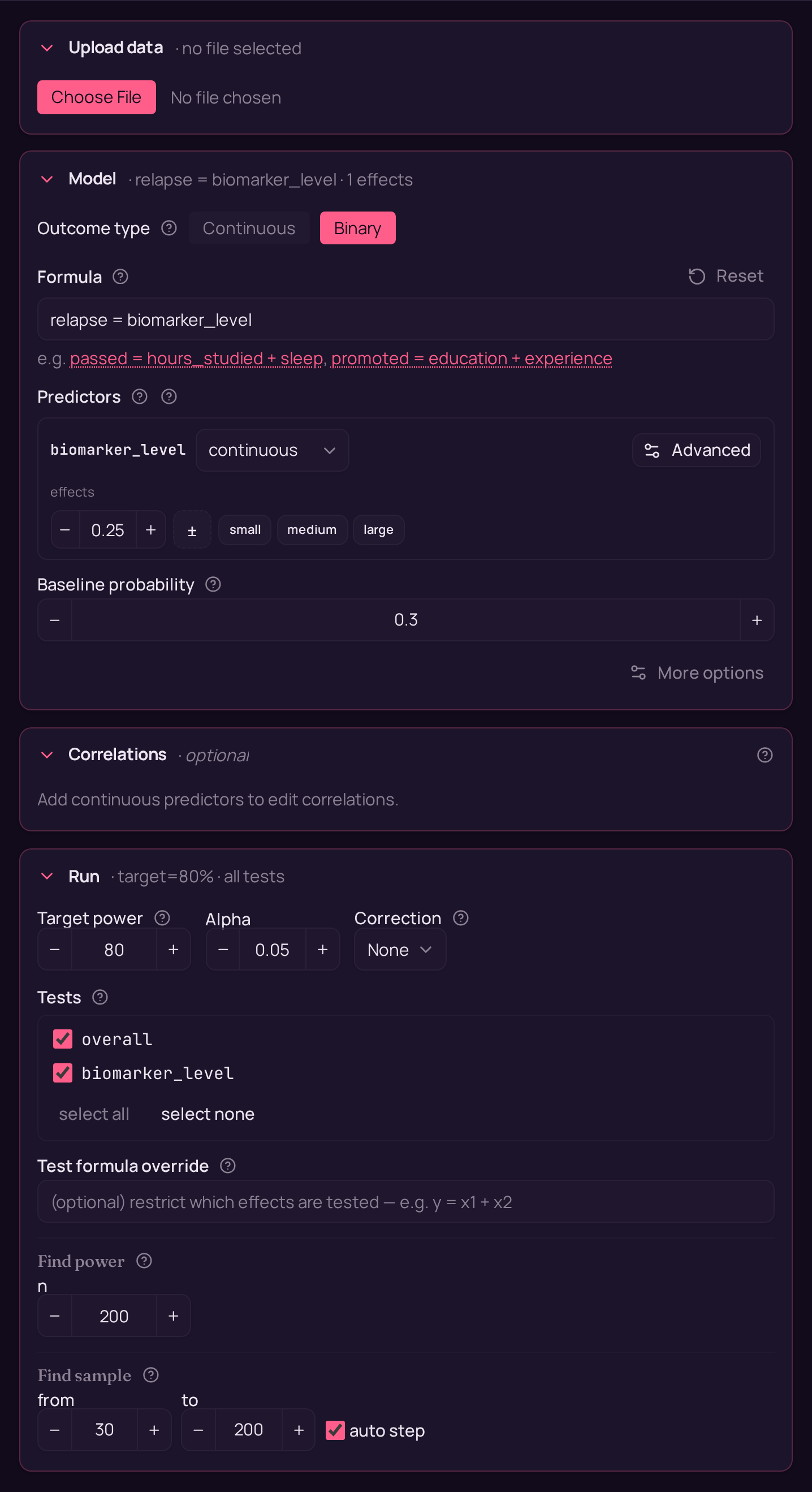
App setup screenshot