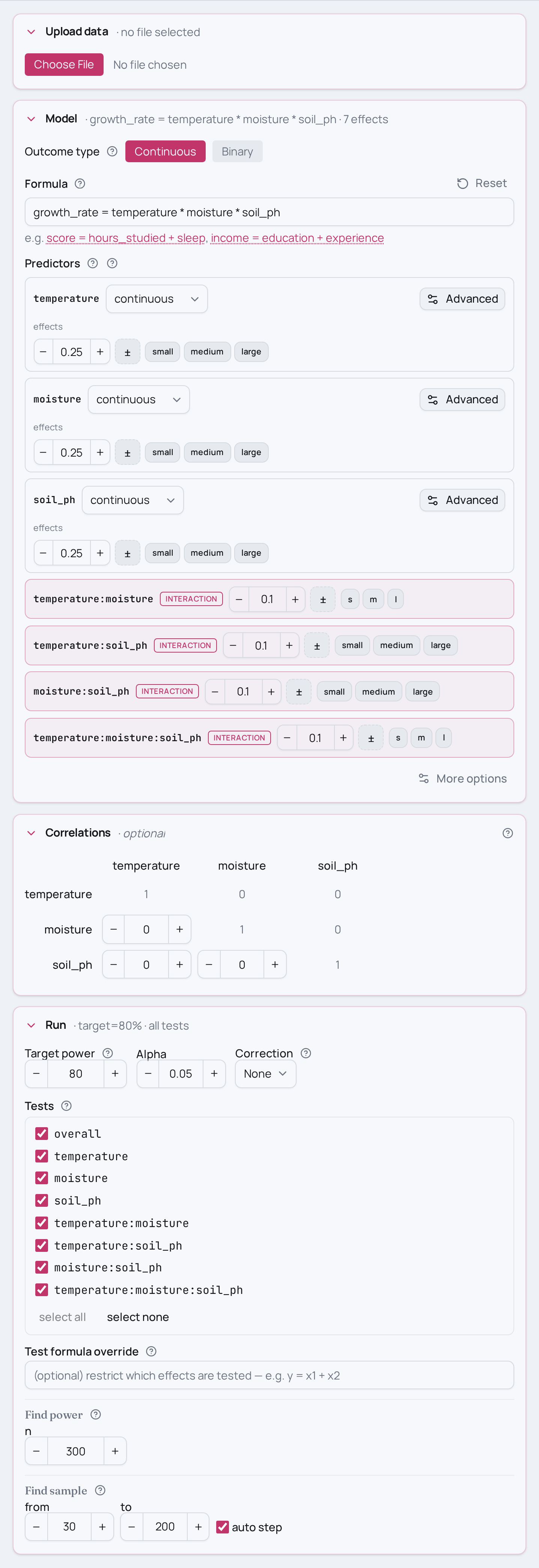
Power for a three-way continuous interaction
You measure a continuous outcome growth_rate and suspect that the way temperature moderates
the effect of moisture on growth rate is itself conditional on soil_ph — a full
three-way moderation. The classic case: an effect of temperature that grows with moisture,
but where that growth is steeper at some levels of soil_ph than others. In MCPower
this is the model growth_rate ~ temperature * moisture * soil_ph, where * expands to all three main
effects, all three two-way interactions, and the single three-way term
temperature:moisture:soil_ph — the coefficient you actually care about here.
Three-way interactions are notoriously underpowered: the highest-order term sits on the thinnest slice of the design, so plausible effects need large samples. This page powers the three-way term itself at a medium-ish sample, with main effects at the medium benchmark (0.25) and every interaction at the small benchmark (0.10).
Variations
- Power every term, not just the three-way. Drop
target_test="temperature:moisture:soil_ph"and the default reports the omnibus F plus every coefficient — useful to see how much more sample the three-way needs than the main effects. - Probe the two-way interactions too. Use
target_test="temperature:moisture, temperature:soil_ph, moisture:soil_ph"to report the three lower-order interactions side by side. - Bigger three-way effect. If theory says the highest-order term is
substantial, raise
temperature:moisture:soil_phto the medium continuous benchmark (0.25) — the required sample drops sharply. - Search for the sample, don't guess it. Swap
find_power(sample_size=300, …)forfind_sample_size(target_test="temperature:moisture:soil_ph")to get the smallest N that hits 80% power for the three-way term. - Correlated predictors. Bump
corr(temperature,moisture)=0.2higher, or addcorr(temperature,soil_ph)/corr(moisture,soil_ph), to reflect predictors that travel together — collinearity erodes interaction power fast. - Same design, other fields:
- Clinical:
recovery_days ~ dose * age * baseline_severity— does a dose×age moderation of recovery time itself depend on baseline disease severity? - Social:
well_being ~ income * social_support * years_education— does the income×social-support moderation of well-being further depend on education level?
- Clinical:
Not this setup?
- ols/ols-04 — two continuous predictors interacting (
income * social_support), the simpler two-way moderation without a third variable. - ols/ols-06 — a neighbouring three-predictor design with a different interaction structure.
If you'd rather have…
- Two continuous predictors interacting — just
temperature * moistureinstead of three, the simpler moderation case. - A two-way interaction plus an additive covariate — moderation while adjusting for another predictor.
- Three continuous predictors, additive only — main effects of
temperature,moisture,soil_phwith no interactions. - An interaction with a categorical term —
group * baseline, where one side of the interaction is a factor rather than continuous.
Copy-paste setup
Python setup
from mcpower import MCPower

model = MCPower("growth_rate ~ temperature * moisture * soil_ph", family="ols")
model.set_effects(
    "temperature=0.25, moisture=0.25, soil_ph=0.25, "
    "temperature:moisture=0.10, temperature:soil_ph=0.10, moisture:soil_ph=0.10, "
    "temperature:moisture:soil_ph=0.10"
)
model.set_correlations("corr(temperature,moisture)=0.2")
model.set_simulations(1600)
model.set_seed(2137)

model.find_power(sample_size=300, target_test="temperature:moisture:soil_ph")
R setup
suppressMessages(library(mcpower))

model <- MCPower$new("growth_rate ~ temperature * moisture * soil_ph", family = "ols")
model$set_effects(paste0(
  "temperature=0.25, moisture=0.25, soil_ph=0.25, ",
  "temperature:moisture=0.10, temperature:soil_ph=0.10, moisture:soil_ph=0.10, ",
  "temperature:moisture:soil_ph=0.10"
))
model$set_correlations("corr(temperature,moisture)=0.2")
model$set_simulations(1600)
model$set_seed(2137)

model$find_power(sample_size = 300, target_test = "temperature:moisture:soil_ph")
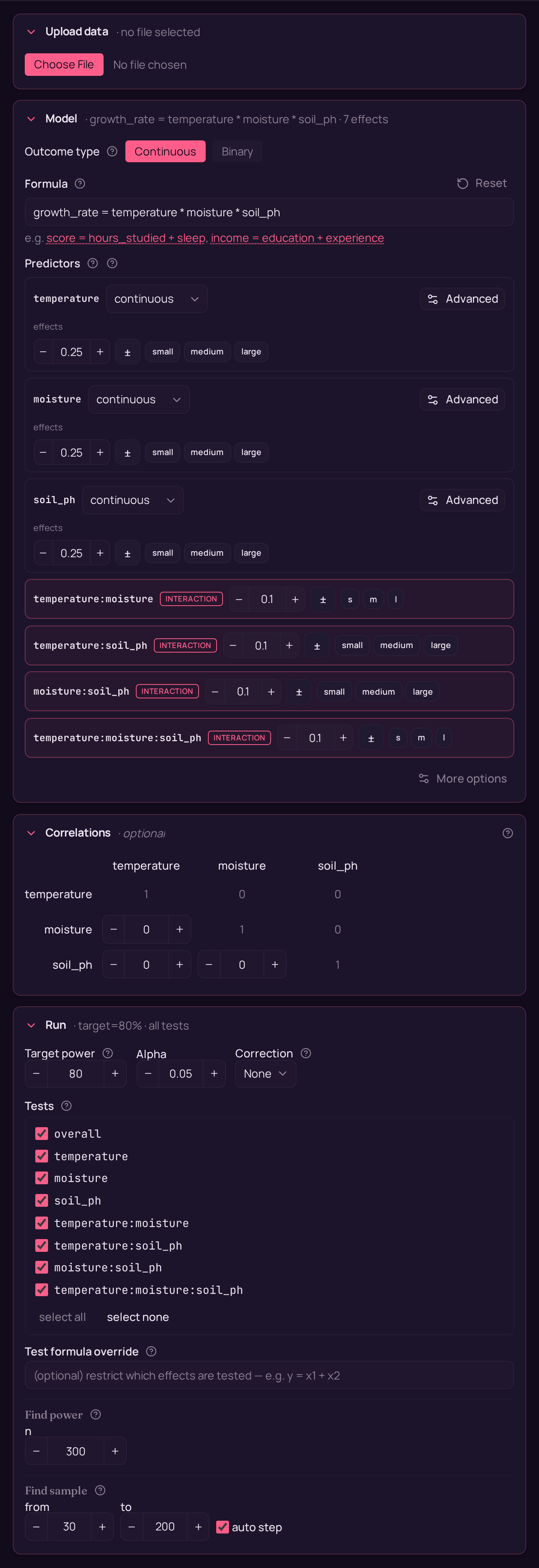
App setup screenshot