Power for an interaction-only regression term
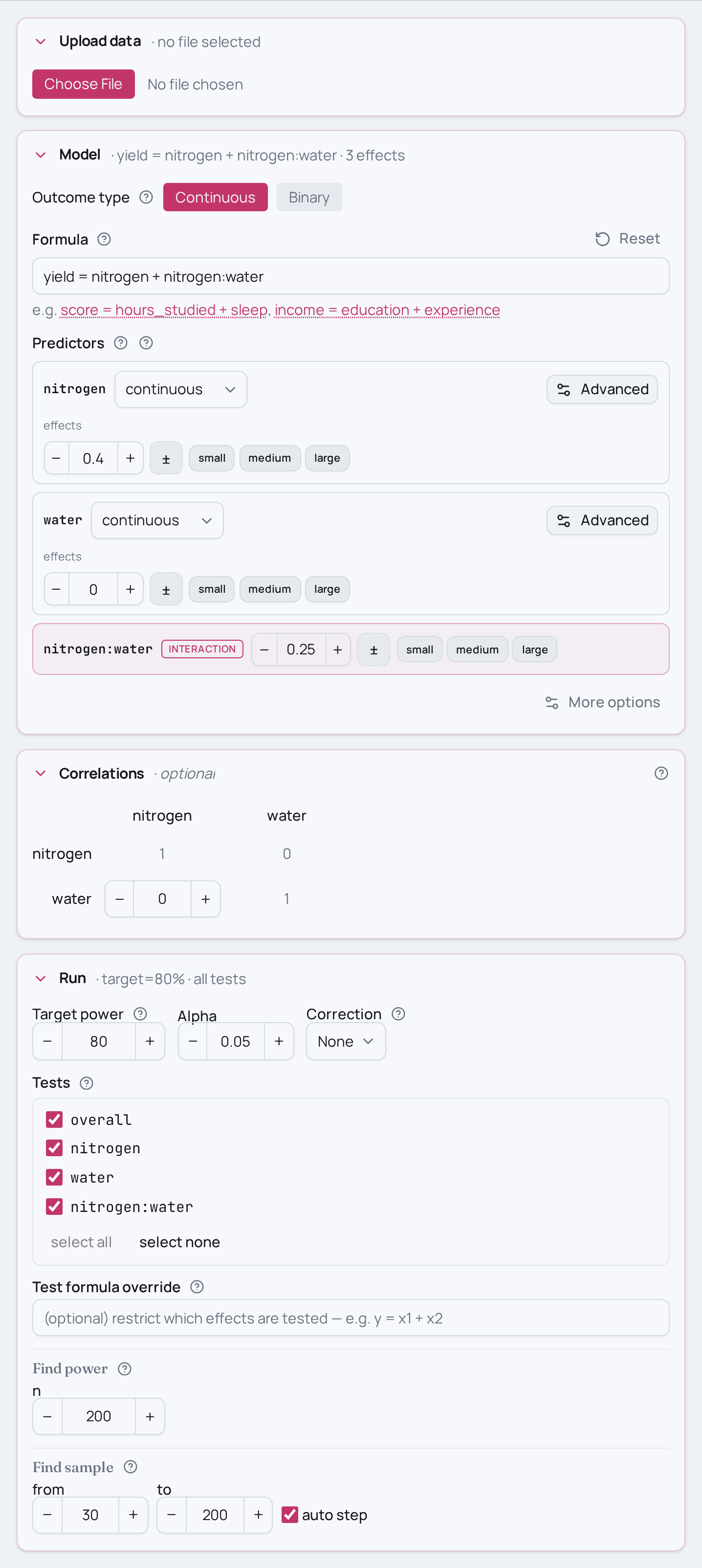
You expect nitrogen to drive a continuous outcome yield, and water to change how strong
that nitrogen effect is — but water has no average effect on yield of its own. This is the
deliberately reduced moderation model yield ~ nitrogen + nitrogen:water: the nitrogen main
slope plus the nitrogen:water product term, with water's own main effect left out on purpose
(: adds the interaction only, never the lower-order term).
Both predictors are continuous, so the interaction column is the product of two uncorrelated standard normals — it has unit variance, and the continuous effect-size benchmarks (small 0.10 / medium 0.25 / large 0.40) apply to it directly.
Variations
- Put
water's main effect back in. Switch the formula toyield ~ nitrogen * water, which expands tonitrogen + water + nitrogen:water, and add awater=effect — the standard full moderation model when you don't want to assumewateris inert on average. - Make the moderator a group. Swap continuous
waterfor a binarywater(viaset_variable_type("water=binary")); the interaction now asks whethernitrogen's slope differs between two groups, and the binary benchmarks (0.20 / 0.50 / 0.80) apply to it. - Let the predictors correlate. Add
set_correlations("corr(nitrogen, water)=0.3"); once the components are correlated the interaction column is no longer unit-variance, so treat its benchmark effect size as approximate. - Find the N instead of the power. Replace the
find_powercall withfind_sample_size(target_test="nitrogen:water", from_size=100, to_size=600, by=25)to sweep for the smallest sample that detects the moderation. - Same design, other fields:
- Clinical:
recovery_days ~ treatment + treatment:baseline_severity— treatment predicts recovery, baseline severity modulates the treatment slope, but baseline severity has no direct average effect. - Social:
wage ~ years_education + years_education:urban— education predicts wage, urban/rural status modulates the education slope, but urban itself has no direct main effect.
- Clinical:
Not this setup?
- well_being ~ income * social_support — full continuous moderation
- plant_biomass ~ rainfall + soil_nitrogen — additive two-predictor regression
- recovery_days ~ dose * age + baseline_severity — moderation with control
If you'd rather have…
- Full continuous-by-continuous moderation (well_being ~ income * social_support) — keeps
both lower-order main effects plus the interaction, the standard form when you
don't want to omit
water's main effect. - Plain additive two-predictor regression (plant_biomass ~ rainfall + soil_nitrogen) — the no-interaction baseline if the product term isn't of interest.
- Continuous moderation with an added covariate (recovery_days ~ dose * age + baseline_severity) — interaction plus statistical control.
- Three-way continuous interaction (growth_rate ~ temperature * moisture * soil_ph) — scales the interaction structure up to a third predictor.
- Binary-by-continuous moderation (wage ~ gender * experience_years) — same interaction idea when the moderator is a two-group factor instead of continuous.
Copy-paste setup
Python setup
from mcpower import MCPower

# Moderation without water's own main effect: nitrogen predicts yield, and that slope is
# modulated by water (nitrogen:water), but water has no average effect of its own.
# `:` is interaction-only — it adds the product term without water's main effect.
model = MCPower("yield = nitrogen + nitrogen:water")

# Both predictors are continuous (the default), so the interaction column is the
# product of two uncorrelated standard normals — unit variance, and the
# continuous benchmarks (0.10 / 0.25 / 0.40) apply to it directly.
#   nitrogen=0.40       -> large main slope.
#   nitrogen:water=0.25 -> medium moderation of that slope.
model.set_effects("nitrogen=0.40, nitrogen:water=0.25")

# Power for the interaction term — the hard-to-detect quantity here.
model.find_power(sample_size=200, target_test="nitrogen:water")
R setup
suppressMessages(library(mcpower))

# Moderation without water's own main effect: nitrogen predicts yield, and that slope is
# modulated by water (nitrogen:water), but water has no average effect of its own.
# `:` is interaction-only — it adds the product term without water's main effect.
model <- MCPower$new("yield ~ nitrogen + nitrogen:water")

# Both predictors are continuous (the default), so the interaction column is the
# product of two uncorrelated standard normals — unit variance, and the
# continuous benchmarks (0.10 / 0.25 / 0.40) apply to it directly.
#   nitrogen=0.40       -> large main slope.
#   nitrogen:water=0.25 -> medium moderation of that slope.
model$set_effects("nitrogen=0.40, nitrogen:water=0.25")

# Power for the interaction term — the hard-to-detect quantity here.
model$find_power(sample_size = 200, target_test = "nitrogen:water")
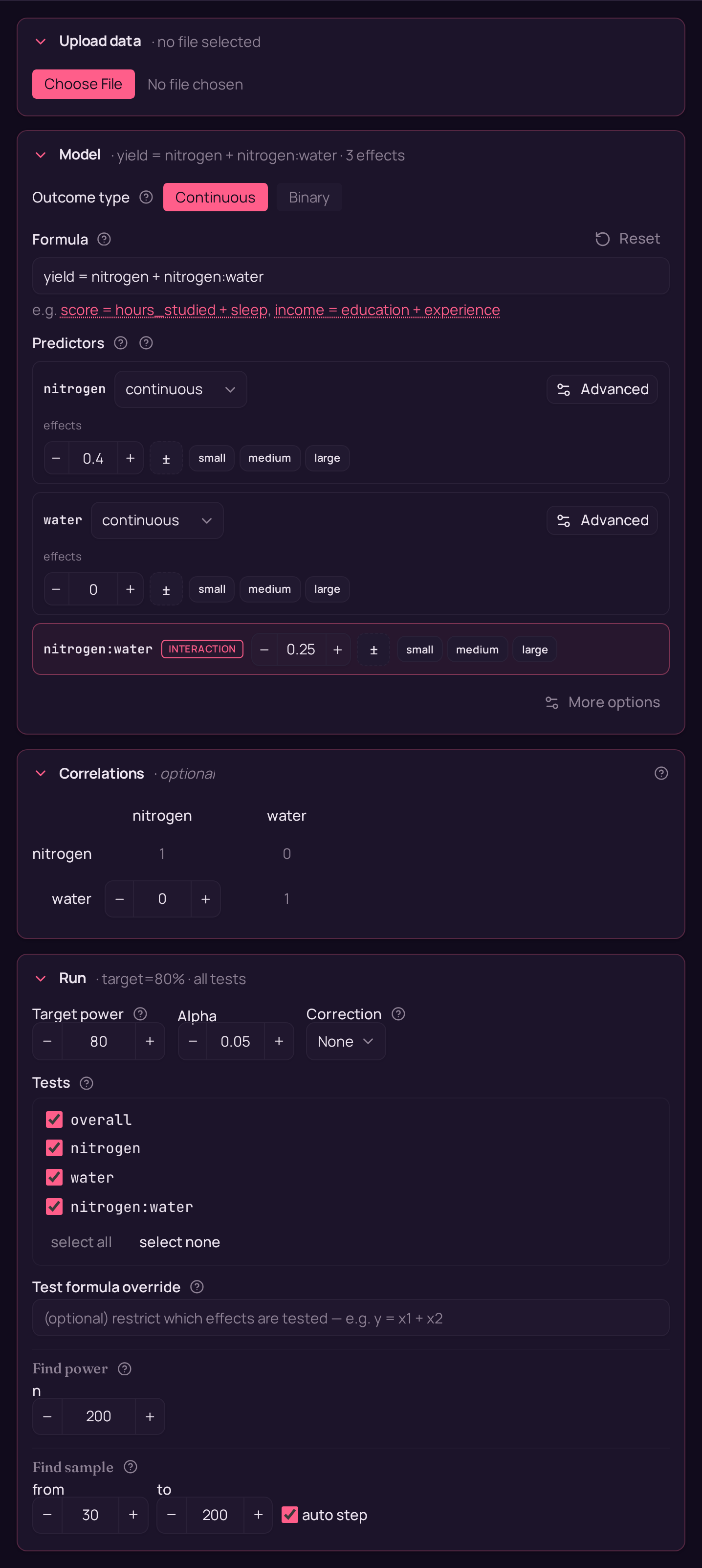
App setup screenshot