Power for a two-way factorial ANCOVA
You have a classic factorial experiment — two crossed treatment factors (treatment arm and patient sex), each applied at two levels, in every combination — but you also measured each patient's systolic blood pressure before the manipulation. Running the plain two-way ANOVA on the post-treatment outcome leaves that baseline's variability in the error term, shrinking every F-test. Folding it in as a covariate soaks up between-subject noise and sharpens both main-effect and interaction tests: this is the two-way factorial ANCOVA, with all cells sharing one common slope on the covariate (parallel slopes).
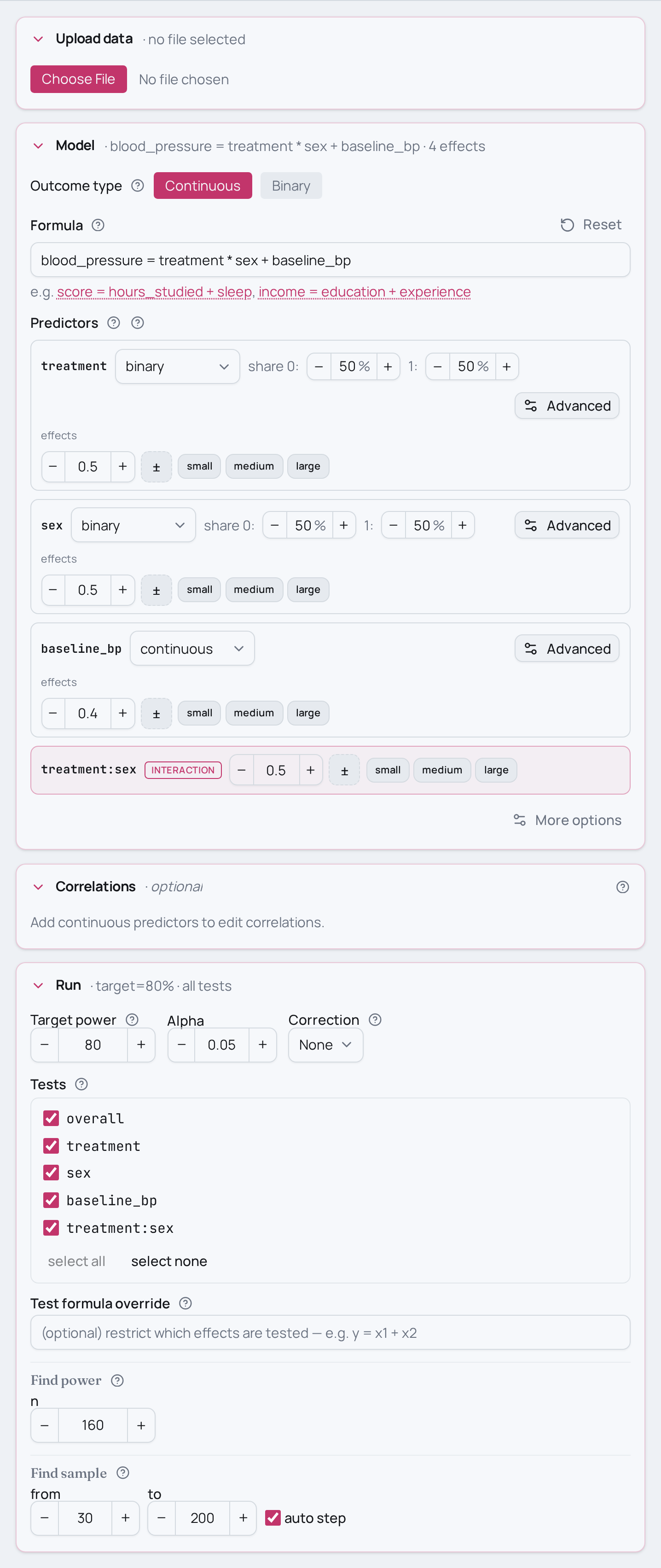
The model is blood_pressure = treatment * sex + baseline_bp — * expands to
treatment + sex + treatment:sex, giving you both main effects plus the
interaction, all read net of the continuous baseline and fit by OLS.
Variations
- Power the interaction, not the main effects. Point
target_testattreatment:sexwhen the cell-difference-of-differences is the hypothesis — interactions usually need a noticeably larger N than main effects to reach the same power. - More than two treatment levels. Swap treatment for a 3-level factor (e.g.
treatment=(factor,3)for placebo, dose A, dose B); the page stays a two-way factorial ANCOVA, now with a multi-level omnibus test on treatment. - A weaker baseline covariate. Dial
baseline_bpdown to the 0.25 medium benchmark (or 0.10 small) when the baseline only loosely predicts the outcome — the adjustment buys you less, so the factor tests need more N to clear power. - Let the slopes diverge. Add a
treatment:baseline_bpterm to test whether the baseline adjustment differs across treatment arms — that turns the parallel-slopes assumption into something you test rather than assume. - Same design, other fields:
seed_yield = watering * habitat + soil_nitrogen— ecology: two binary crop factors adjusted for soil nitrogen baselinehourly_wage = sector * gender + experience_years— social science: sector-by-gender wage model adjusted for experience
Not this setup?
- Plain two-way factorial ANOVA — the same
treatment * sexdesign with no covariate adjustment. - Single-factor ANCOVA — one group factor adjusted for a baseline covariate, instead of a two-way factorial.
- Three-way factorial ANOVA — add a third crossed factor instead of a continuous covariate.
If you'd rather have…
- Drop the covariate — plain two-way factorial ANOVA with interaction (
blood_pressure = treatment * sex), no covariate adjustment. - Single-factor ANCOVA — one group factor adjusted for a baseline covariate (
blood_pressure = treatment + baseline_bp), instead of a two-way factorial. - Add a third factor instead of a covariate — three-way factorial ANOVA (
seed_yield = watering * nitrogen * light). - The same two interacting predictors as regression coefficients/contrasts (
blood_pressure = treatment * sex) rather than ANOVA omnibus tests. - ANCOVA where the covariate interacts with the factor — homogeneity-of-slopes test (
blood_pressure = treatment * baseline_bp), rather than a parallel-slopes covariate adjustment.
Copy-paste setup
Python setup
from mcpower import MCPower

# Two-way factorial ANCOVA: blood pressure crossed by treatment and sex, adjusted
# for a continuous baseline_bp covariate. '*' expands treatment * sex to
# treatment + sex + treatment:sex, so both main effects and the interaction are
# fitted, each read net of baseline_bp (parallel slopes, common slope across all cells).
model = MCPower("blood_pressure = treatment * sex + baseline_bp")

# treatment and sex are two-level factors; baseline_bp stays continuous by default.
model.set_variable_type("treatment=binary, sex=binary")

# Effect sizes on the benchmark scales.
#   treatment=0.50          → medium main effect (factor benchmark 0.20/0.50/0.80).
#   sex=0.50                → medium main effect.
#   treatment:sex=0.50      → medium interaction (the cell-difference-of-differences).
#   baseline_bp=0.40        → strong continuous covariate (benchmark 0.10/0.25/0.40).
model.set_effects("treatment=0.50, sex=0.50, treatment:sex=0.50, baseline_bp=0.40")

model.set_seed(2137)

# Power for both main effects at N=160 (the adjusted factorial F-tests).
model.find_power(sample_size=160, target_test="treatment, sex")
R setup
suppressMessages(library(mcpower))

# Two-way factorial ANCOVA: blood pressure crossed by treatment and sex, adjusted
# for a continuous baseline_bp covariate. '*' expands treatment * sex to
# treatment + sex + treatment:sex, so both main effects and the interaction are
# fitted, each read net of baseline_bp (parallel slopes, common slope across all cells).
model <- MCPower$new("blood_pressure ~ treatment * sex + baseline_bp")

# treatment and sex are two-level factors; baseline_bp stays continuous by default.
model$set_variable_type("treatment=binary, sex=binary")

# Effect sizes on the benchmark scales.
#   treatment=0.50          -> medium main effect (factor benchmark 0.20/0.50/0.80).
#   sex=0.50                -> medium main effect.
#   treatment:sex=0.50      -> medium interaction (the cell-difference-of-differences).
#   baseline_bp=0.40        -> strong continuous covariate (benchmark 0.10/0.25/0.40).
model$set_effects("treatment=0.50, sex=0.50, treatment:sex=0.50, baseline_bp=0.40")

model$set_seed(2137)

# Power for both main effects at N=160 (the adjusted factorial F-tests).
invisible(model$find_power(sample_size = 160, target_test = "treatment, sex"))
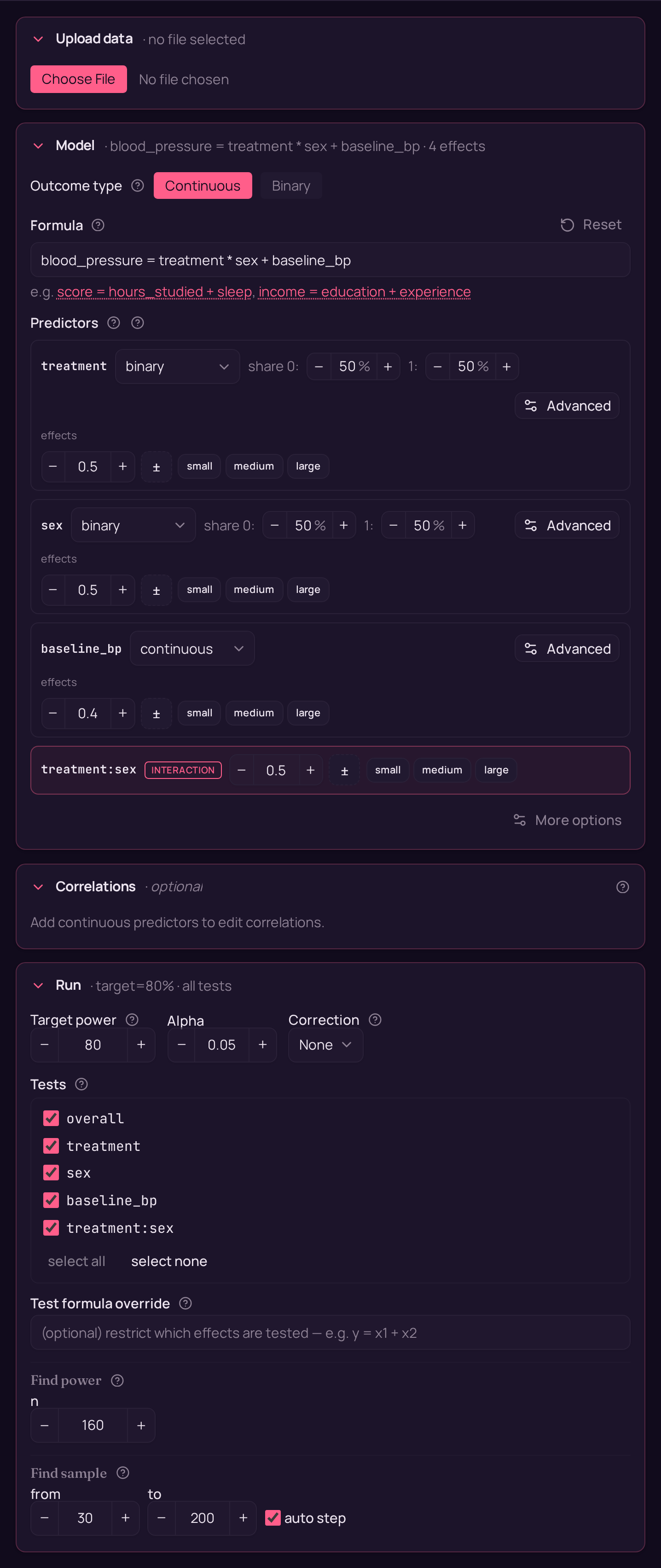
App setup screenshot