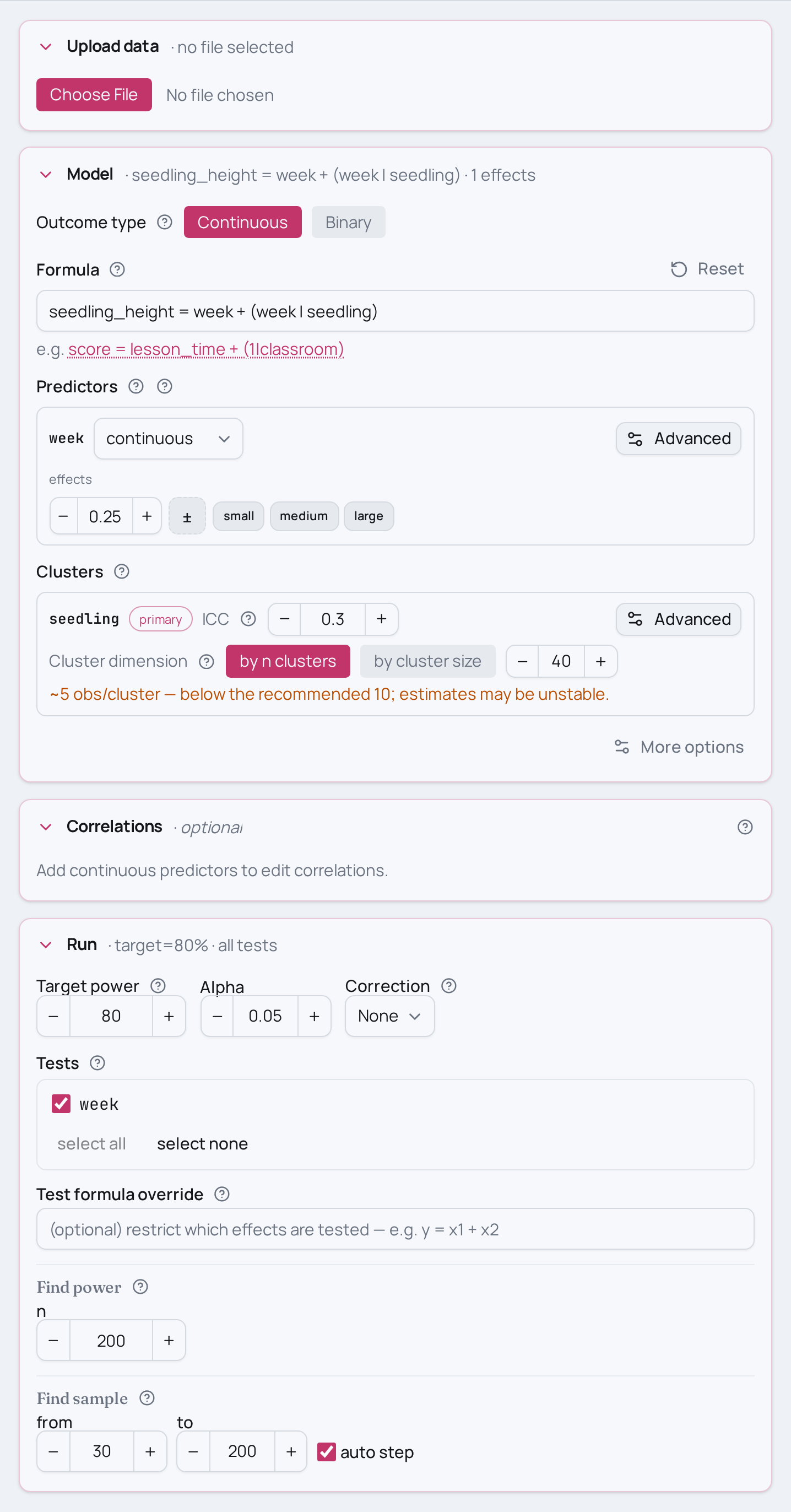
Power for a random-slope growth curve model
Every seedling is measured at several weekly time points, and the question is
whether height moves with week on average. Because seedlings start at different
heights and grow at different rates, each seedling gets its own intercept and its
own slope of week. As an MCPower formula:
seedling_height ~ week + (week | seedling), fit as a linear mixed model (the
default MLE estimator). The test of interest is the average week slope,
judged against how widely the individual growth rates scatter.
Variations
- Drop the random slope. If individual growth rates are not your concern,
use
seedling_height ~ week + (1 | seedling)— random intercepts only. Every seedling shares one average slope, which usually raises power forweekbecause the slope no longer competes with between-seedling slope variance. - More seedlings vs. more measurements. Power for a fixed total
sample_sizeshifts with the seedling/measurement split; raisen_clusters(more seedlings, fewer measurements each) or lower it (fewer seedlings, denser follow-up) to see which your design can afford. - Tighter or looser individual trajectories. Raise
slope_varianceto model seedlings whose growth rates differ a lot (harder to detect the average slope), or lower it toward zero to approach a common-slope design. - Swap the trend strength. Replace
week=0.25withweek=0.10(small) orweek=0.40(large) to bracket a plausible average growth rate. - Same design, other fields:
systolic_bp ~ phase + (phase|patient)— one patient measured at several clinical phases; individual BP trajectories vary in slope (clinical).life_satisfaction ~ wave + (wave|individual)— one person surveyed repeatedly; individual well-being slopes vary (social science).
Not this setup?
- Random intercept only — one shared week slope
- A fertilizer treatment that moderates the individual slopes
- Random slope that varies across sites, not seedlings
If you'd rather have…
- Random intercept only — same week-trend design but the simpler form: random intercept only, no random slope of week.
- Conditional growth with a fertilizer treatment — adds a treatment that moderates the individual slopes, layering conditional growth on top of this same random-slope structure.
- Treatment x week, random intercept only — a treatment x week interaction but with random intercept only — a between-arm trajectory difference without random slopes.
- Random slope over sites — another random-slope design, but the slope varies over clusters (sites) for a treatment effect rather than over time within seedlings.
- Random slope on a binary outcome — the same random-slope idea on a binary outcome: a continuous predictor with a random slope per subject (logistic GLMM).
Copy-paste setup
Python setup
from mcpower import MCPower

# Repeated-measures growth curve: each seedling is measured at several weekly
# time points and we ask whether height changes with `week`. `(week | seedling)`
# gives every seedling its own random intercept (baseline height) AND its own
# random slope of week (personal growth rate), so the test of the average
# `week` slope is judged against how much those individual growth rates scatter.
# family="lme" with the default MLE estimator fits the mixed model.
model = MCPower("seedling_height ~ week + (week | seedling)", family="lme")

# `week` is a continuous (normally distributed) within-seedling predictor.
model.set_variable_type("week=normal")

# Average weekly growth slope on the continuous benchmark scale:
#   week=0.25 -> a medium average rate of change across seedlings.
model.set_effects("week=0.25")

# Clustering by seedling: 40 seedlings, conditional ICC 0.3 (baseline
# heights correlate within a seedling after `week` is accounted for), and a
# random slope of `week` whose variance 0.05 sets how much individual growth
# rates differ; slope_intercept_corr ties taller seedlings to faster growth.
model.set_cluster(
    "seedling",
    ICC=0.3,
    n_clusters=40,
    random_slopes=["week"],
    slope_variance=0.05,
    slope_intercept_corr=0.2,
)

model.set_seed(2137)

# Power for the average `week` slope. sample_size is the total number of
# observations (seedlings x measurements per seedling).
model.find_power(sample_size=200, target_test="week")
R setup
suppressMessages(library(mcpower))

# Repeated-measures growth curve: each seedling is measured at several weekly
# time points and we ask whether height changes with `week`. `(week | seedling)`
# gives every seedling its own random intercept (baseline height) AND its own
# random slope of week (personal growth rate), so the test of the average
# `week` slope is judged against how much those individual growth rates scatter.
# family="lme" with the default MLE estimator fits the mixed model.
model <- MCPower$new("seedling_height ~ week + (week | seedling)", family = "lme")

# `week` is a continuous (normally distributed) within-seedling predictor.
model$set_variable_type("week=normal")

# Average weekly growth slope on the continuous benchmark scale:
#   week=0.25 -> a medium average rate of change across seedlings.
model$set_effects("week=0.25")

# Clustering by seedling: 40 seedlings, conditional ICC 0.3 (baseline
# heights correlate within a seedling after `week` is accounted for), and a
# random slope of `week` whose variance 0.05 sets how much individual growth
# rates differ; corr_with_intercept ties taller seedlings to faster growth.
model$set_cluster(
  "seedling",
  ICC = 0.3,
  n_clusters = 40L,
  random_slopes = list(
    list(predictor = "week", variance = 0.05, corr_with_intercept = 0.2)
  )
)

model$set_seed(2137)

# Power for the average `week` slope. sample_size is the total number of
# observations (seedlings x measurements per seedling).
invisible(model$find_power(sample_size = 200, target_test = "week"))
App setup screenshot