Power for a treatment x time mixed model
You ran a longitudinal pain intervention study: every patient was assessed at multiple weekly visits, and each was assigned to either the treatment arm or the control arm. You want the power to detect that the treatment arm's pain score changed more over weeks than the control arm did — the difference-in-differences — while accounting for the fact that a patient's repeated measurements are correlated.
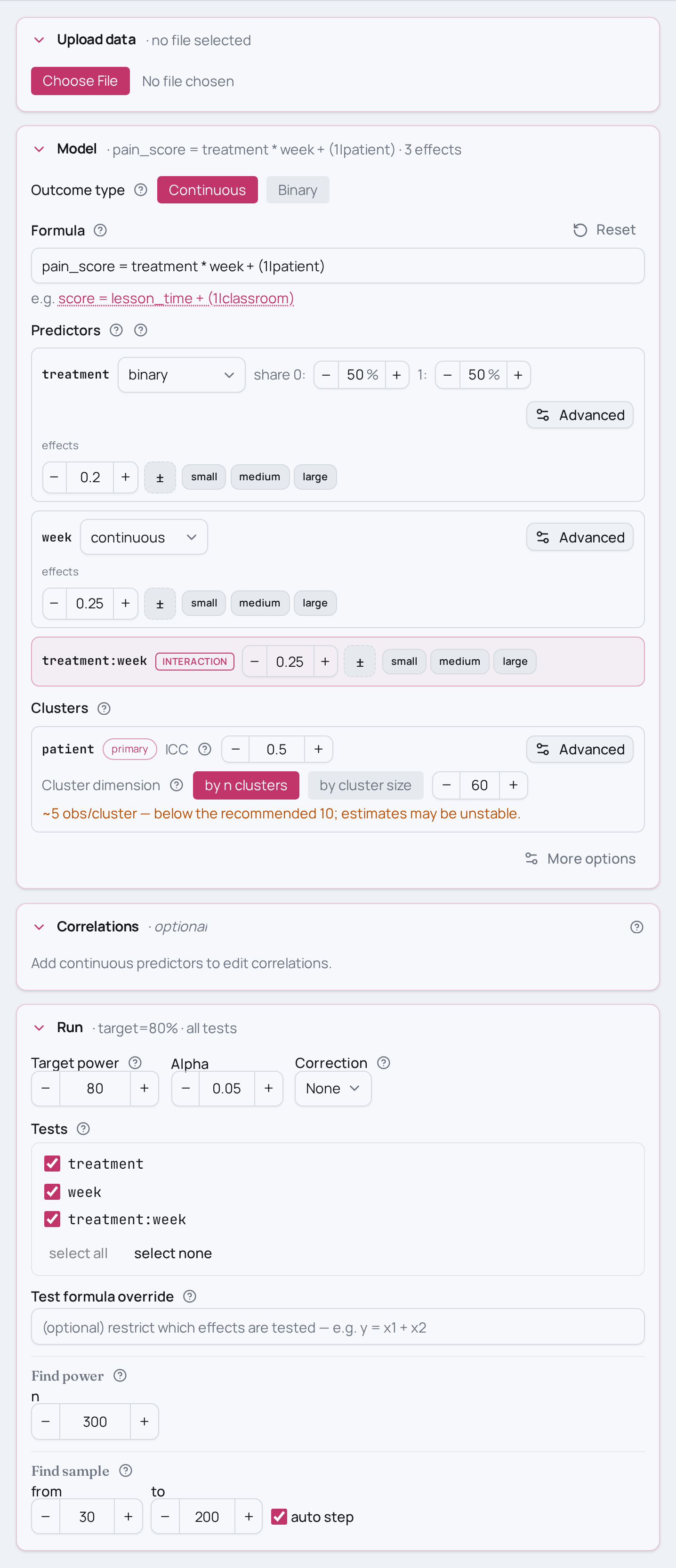
As an MCPower model this is pain_score = treatment * week + (1|patient) with
family="lme", where treatment is a binary arm indicator and week is a
continuous measurement-occasion covariate. The (1|patient) random intercept
lets each patient have their own baseline pain level. The * expands to the
treatment and week main effects plus the treatment:week interaction; that
interaction is the diff-in-diff, and it is what you read power off.
family="lme" fits the model by maximum likelihood (the MLE estimator), so the
within-patient correlation widens the standard errors the way it would in a real
mixed-model fit.
Variations
- More than five timepoints. A finer follow-up schedule simply increases
sample_sizewhile holdingn_clustersconstant; the observations-per-cluster floor (at least 5) stays relevant — make sure total N / n_clusters ≥ 5. - Stronger or weaker correlation between occasions. The
ICCis how much of the variance sits between patients; bump it toward0.70for tightly tracking repeated measures or down toward0.20for loosely related ones, and watch how the within-patient design either gains or loses its advantage. - More patients vs more visits.
n_clustersis the patient count and the sample size is patients x occasions. Adding patients is usually the more efficient lever for the interaction than adding visits per patient. - Search for the N instead of fixing it. Swap the
find_powercall forfind_sample_size(target_test="treatment:week", from_size=80, to_size=400, by=20)to get the smallest N that reaches target power on the diff-in-diff term. - Same design, other fields:
seedling_height ~ fertilizer * week + (1|seedling)— one plant per fertilizer arm, measured weekly; test whether growth rates diverge (ecology).well_being ~ intervention * wave + (1|individual)— one person per arm, assessed at several waves; test whether well-being trajectories differ (social science).
Not this setup?
- Same treatment-by-week design, but let each patient have their own week slope
- Drop the treatment arm: simple repeated measures with just a phase effect
- The same group-by-time difference-in-differences, but for a binary outcome
If you'd rather have…
- lmm/lmm-04 — Same treatment x week interaction but lets each patient
have their own week slope (
week | patient) — the conditional growth-curve version when individual trajectories vary. - lmm/lmm-01 — Drop the treatment arm: simple repeated measures with just a phase effect and a random intercept per patient.
- lmm/lmm-03 — Single-arm linear growth curve — week as a continuous slope with a random intercept and slope, no treatment factor.
- glmm/glmm-03 — Same group x time difference-in-differences design but for a binary outcome (logistic GLMM).
- lmm/lmm-05 — Two-arm trial with a random intercept but clustered (cluster-randomised) rather than longitudinal repeated measures — treatment main effect only, no week interaction.
Copy-paste setup
Python setup
# NOTE: Reframed from a 2-occasion (pre/post) design to a 5-occasion repeated-
# measures design. The original 60 patients x 2 occasions gave only 2
# observations per cluster, which the mixed-model validator rejects (it requires
# at least 5 observations per cluster for reliable estimation). Raising
# sample_size to 300 yields 5 occasions per patient, clearing the floor, and
# `week` is now a continuous (normal) measurement-occasion covariate instead of
# binary.
from mcpower import MCPower

# Two-arm longitudinal pain trial (difference-in-differences): every patient is
# assessed repeatedly over weeks, in either the treatment or the control arm.
# Research question: does the treatment reduce pain MORE than control does over
# time? -> the treatment:week interaction. '*' expands
# treatment * week to treatment + week + treatment:week, so both main effects
# and the diff-in-diff interaction are fitted. family="lme" adds the
# (1|patient) random intercept and fits by maximum likelihood (MLE estimator).
model = MCPower("pain_score = treatment * week + (1|patient)", family="lme")

# treatment is the two arms; week is the continuous measurement occasion.
model.set_variable_type("treatment=binary, week=normal")

# Effect sizes on the benchmark scale:
#   treatment=0.20 (factor)     -> small baseline arm gap (groups nearly balanced).
#   week=0.25 (continuous)      -> medium overall drift over weeks (both arms move).
#   treatment:week=0.25         -> medium diff-in-diff: the treatment arm's slope
#                                  over weeks exceeds the control arm's (the target).
model.set_effects("treatment=0.20, week=0.25, treatment:week=0.25")

# Repeated measures: ICC=0.50 of the variance is between-patient (the
# occasions per person are strongly correlated) across 60 patients.
model.set_cluster("patient", ICC=0.50, n_clusters=60)

model.set_simulations(800)
model.set_seed(2137)

# Power at N=300 (60 patients x 5 occasions) for the diff-in-diff interaction.
model.find_power(sample_size=300, target_test="treatment:week")
R setup
# NOTE: Reframed from a 2-occasion (pre/post) design to a 5-occasion repeated-
# measures design. The original 60 patients x 2 occasions gave only 2
# observations per cluster, which the mixed-model validator rejects (it requires
# at least 5 observations per cluster for reliable estimation). Raising
# sample_size to 300 yields 5 occasions per patient, clearing the floor, and
# `week` is now a continuous (normal) measurement-occasion covariate instead of
# binary.
suppressMessages(library(mcpower))

# Two-arm longitudinal pain trial (difference-in-differences): every patient is
# assessed repeatedly over weeks, in either the treatment or the control arm.
# Research question: does the treatment reduce pain MORE than control does over
# time? -> the treatment:week interaction. '*' expands
# treatment * week to treatment + week + treatment:week, so both main effects
# and the diff-in-diff interaction are fitted. family="lme" adds the
# (1|patient) random intercept and fits by maximum likelihood (MLE estimator).
model <- MCPower$new("pain_score ~ treatment * week + (1|patient)", family = "lme")

# treatment is the two arms; week is the continuous measurement occasion.
model$set_variable_type("treatment=binary, week=normal")

# Effect sizes on the benchmark scale:
#   treatment=0.20 (factor)     -> small baseline arm gap (groups nearly balanced).
#   week=0.25 (continuous)      -> medium overall drift over weeks (both arms move).
#   treatment:week=0.25         -> medium diff-in-diff: the treatment arm's slope
#                                  over weeks exceeds the control arm's (the target).
model$set_effects("treatment=0.20, week=0.25, treatment:week=0.25")

# Repeated measures: ICC=0.50 of the variance is between-patient (the
# occasions per person are strongly correlated) across 60 patients.
model$set_cluster("patient", ICC = 0.50, n_clusters = 60)

model$set_simulations(800)
model$set_seed(2137)

# Power at N=300 (60 patients x 5 occasions) for the diff-in-diff interaction.
invisible(model$find_power(sample_size = 300, target_test = "treatment:week"))
App setup screenshot